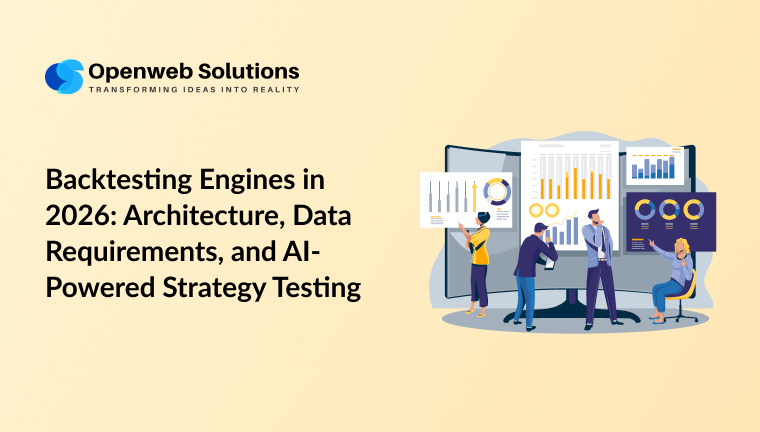
Deploying an untested strategy into live markets is a liability in today’s trading landscape. Robust engine development has become a cornerstone of every serious trading operation as algorithmic trading volumes surge. A custom backtesting platform allows traders and fintech firms to simulate how a strategy would have performed against historical data. The new frontier combines event-driven architecture and AI-assisted pattern evaluation to make strategy testing smarter. This blog explores what goes into building data needs to the role artificial intelligence now plays in validating trading strategies.
Table of Contents
Definition of a Backtesting Engine
A trading strategy is a software system that replays historical market data through a defined set of trading rules to evaluate performance metrics such as returns and Sharpe ratios. Modern algo trading backtest platforms go well beyond simple price-based simulations. They factor in book depth and liquidity constraints that can change a strategy’s real-world viability.
Core Architecture of a Modern Backtesting Engine
Building a performant engine in 2026 requires a carefully layered architecture:
1. Data Ingestion Layer normalizes and pipes in historical data with OHLCV and alternative data feeds into a unified format the engine can process.
2. Event Engine is the heart of any serious platform that is an event-driven core. An engine processes MarketEvent and FillEvent objects in sequence closely mimicking the reality of live trading.
3. Strategy Module is where trading logic lives. A clean strategy module should be decoupled from data handling, allowing quants to write and swap strategies without touching infrastructure code.
4. Execution Simulation model simulates partial fills and broker routing delays. The results will be optimistically misleading.
5. Performance Analytics Post-simulation generates risk-adjusted metrics and equity curve visualizations to help traders evaluate and compare strategies objectively.
Data Requirements for Reliable Backtesting
The quality of your back test is only as good as your data that must handle for a custom platform to deliver trustworthy results in 2026:
- Tick-level and intraday data for high-frequency strategy testing
- PIT fundamental data to avoid look-ahead bias in factor-based strategies
- Corporate action adjustments to prevent distorted price histories
- Multi-asset covering equities, futures, options, currencies, and crypto
- Alternative data with sentiment signals for commodity trading
Time-series databases like Arctic are purpose-built for the making them far superior to traditional relational databases for this use case.
AI-Powered Strategy Testing in 2026
The most significant evolution in backtesting engine development over the past two years is the deep integration of artificial intelligence into the testing pipeline.
Strategy Discovery with ML Machine learning models can now scan thousands of feature combinations and identify statistical patterns in historical data.
Overfitting Detection AI-powered walk-forward analysis and Monte Carlo simulations automatically flag strategies to historical noise.
Natural Language Strategy Prompting In 2026 that allow traders to describe strategies in plain language which an LLM-backed interpreter translates into executable backtesting logic.
Regime-Aware Testing AI classifiers can label historical market regimes and run strategies selectively within each regime for a far more nuanced performance breakdown.
Why Build a Backtesting Platform?
Off-the-shelf tools like Zipline serve general purposes well, but growing brokerages and fintech startups increasingly need custom platforms for their specific instruments and risk frameworks.
A purpose-built trading strategy testing engine delivers:
- Full control over execution simulation models
- Smooth integration with proprietary data feeds and internal risk systems
- White-labeling for client-facing strategy portals
- Support for exchange-specific instruments in the Indian market
We have been building specialized stock market software since 2010 from multi-exchange trading dashboards to full-scale algo trading infrastructure. Our teams are experienced in architecting systems that handle real-world complexity.
Build Your Custom Platform with Us
We specialize in stock market software development including custom engines and real-time trading dashboards. We build systems that perform when it matters most with 12+ years of domain expertise and deep technical capabilities.
Request a Free Consultation
Conclusion
Backtesting is a sophisticated engineering discipline. A well-designed engine must combine event-driven precision and AI-powered validation to give traders genuine confidence before deploying capital. Investing in the right infrastructure pays dividends that compound over time whether you are a brokerage building tool for clients or a proprietary desk refining strategy.
FAQs
Q1. What is the difference between backtesting and paper trading?
Backtesting simulates a strategy against historical data and paper trading tests it in live market conditions without real money.
Q2. How much historical data do I need for a reliable algo trading back test?
2–5 years of tick or minute-level data is sufficient for intraday strategies and 10–20 years of daily for long-term macro or fundamental strategies.
Q3. What programming languages are best for building a backtesting engine?
Python is the most popular choice due to its rich ecosystem and C++ is preferred for high-frequency systems.
Q4. How does AI improve backtesting accuracy?
AI enhances automated feature engineering, regime detection, and Monte Carlo stress testing.

Partha Ghosh is the Digital Marketing Strategist and Team Lead at PiTangent Analytics and Technology Solutions. He partners with product and sales to grow organic demand and brand trust. A 3X Salesforce certified Marketing Cloud Administrator and Pardot Specialist, Partha is an automation expert who turns strategy into simple repeatable programs. His focus areas include thought leadership, team management, branding, project management, and data-driven marketing. For strategic discussions on go-to-market, automation at scale, and organic growth, connect with Partha on LinkedIn.