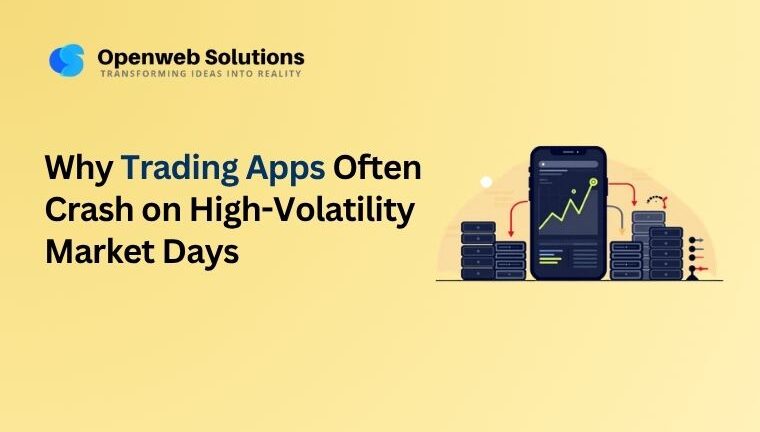
Traders expect their trading apps to work flawlessly. A trading app crash on market crash days is rarely caused by a single issue. Extreme volatility creates a sudden increase in users and market data traffic. Every component from the mobile application and backend servers to the broker’s order-management can come under exceptional pressure. NSE itself emphasizes scalability and periodic capacity enhancements as trading loads increase. Understanding these pressure points is essential for brokers and fintech companies to build reliable trading platforms.
Table of Contents
Why Trading Apps Struggle During Market Crashes
A normal trading session produces relatively predictable traffic. The market crash is different. This creates a traffic spike that can be many times higher than normal. The result can be a chain reaction:
Market volatility → more users → more requests → overloaded infrastructure → delayed responses → retries → even more requests → system degradation.
This is why an app not working during market crash conditions can be an infrastructure problem rather than simply a mobile-app problem.
Sudden Traffic and Order Volume
One of the biggest challenges is the sheer volume of activity. Brokerage platforms have a finite processing capacity. Orders can enter queues before being transmitted to the exchange. The problem becomes particularly serious when thousands of users repeatedly submit the same request because they believe their first request failed. A properly engineered platform therefore needs:
- Horizontal server scaling
- Load balancing
- Queue-based order processing
- Rate limiting
- Connection pooling
- Automatic failover
- Capacity monitoring
Server and API Bottlenecks
A trading application is more than its mobile or web interface. Users may perceive the entire application as being down. This is one reason a broker server down incident can produce different symptoms for different customers. SEBI’s technology framework recognizes the importance of capacity planning across the entire trading and risk-management ecosystem.
Market Data Feed Overload
Prices can change rapidly across thousands of securities. Trading applications need to process and distribute enormous amounts of:
- Live prices
- Bid/ask updates
- Market depth
- Order status
- Portfolio values
- P&L changes
- Technical indicators
Charts may freeze or display stale information even though the exchange itself is functioning normally. A modern trading platform should therefore use scalable streaming architecture and resilient real-time data pipelines rather than repeatedly querying databases for every user’s request.
Network and Third-Party Dependencies
Not every outage originates inside the broker’s infrastructure. Trading platforms depend on exchanges and other external services. This demonstrates an important lesson: redundancy must extend beyond your own servers.
What Happens When a Broker Server Goes Down?
Several things can happen:
- Users cannot log in.
- Market data stops refreshing.
- Orders remain pending.
- Order status updates are delayed.
- Portfolio values become temporarily inaccurate.
- API requests time out.
- Users repeatedly retry requests.
- Customers support traffic spikes.
How Trading Apps Can Be Built for High Volatility
Preventing crashes requires designing the worst expected load, not the average trading day. Important engineering practices include:
- Auto-scaling infrastructure to handle sudden demand.
- Redundant servers and data centers to eliminate single points of failure.
- Distributed order management architecture for high-throughput processing.
- Caching and streaming technologies for market data delivery.
- Circuit breakers and rate limits to prevent cascading failures.
- Load and stress testing using realistic market crash scenarios.
- Disaster-recovery systems with tested failover procedures.
Build a Trading Platform That Can Handle Market Volatility
A trading platform should be tested for the worst market day. Openweb Solutions specializes in custom stock-market software development and multi-market capabilities.
Conclusion
A trading app crash on market crash days isn’t simply an inconvenience. Trading platforms need resilient architecture and rigorous stress testing. The objective should be simple to build the platform to survive the day when everyone wants to trade at exactly the same time.
FAQs
Q1. Why does my trading app stop work during a market crash?
Extreme volatility can cause sudden increases in login and market data traffic. This can overload one or more components of the trading infrastructure.
Q2. Does a broker server going down mean the stock exchange is down?
A broker server down situation can occur while the exchange continues operating normally. Problems can occur anywhere between the user’s device and exchange systems.
Q3. Can trading apps be designed to prevent crashes?
Auto-scaling with redundant infrastructure and extensive stress testing can significantly improve resilience.

Partha Ghosh is the Digital Marketing Strategist and Team Lead at PiTangent Analytics and Technology Solutions. He partners with product and sales to grow organic demand and brand trust. A 3X Salesforce certified Marketing Cloud Administrator and Pardot Specialist, Partha is an automation expert who turns strategy into simple repeatable programs. His focus areas include thought leadership, team management, branding, project management, and data-driven marketing. For strategic discussions on go-to-market, automation at scale, and organic growth, connect with Partha on LinkedIn.