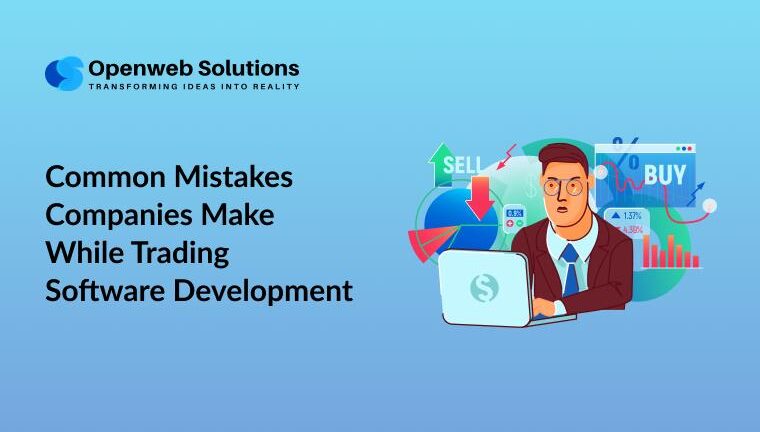
Building reliable and high-performance trading software is far more complex than developing a standard web or mobile application. Whether it’s a trading app for retail investors or an enterprise-grade trading platform software for brokers, even small missteps can lead to performance issues or loss of user trust. Many companies jump into trading app development driven by market demand, but without fully understanding the technical and user-experience challenges involved. As a result, they end up with software that struggles to scale or doesn’t meet user expectations. In this blog, we explore the most common mistakes companies make with trading software development and how to avoid them.
Table of Contents
- Ignoring Real-Time Performance Requirements
- Underestimating Security and Compliance
- Poor User Experience and Interface Design
- Lack of Scalability Planning
- Inadequate Market Data Integration
- Skipping Customization and Flexibility
- Weak Testing and Quality Assurance
- Choosing the Wrong Development Partner
- Conclusion
Ignoring Real-Time Performance Requirements
One of the biggest mistakes in trading software is failing to prioritize real-time performance. Stock prices and market depth data must update instantly. Even a few seconds of delay can impact trading decisions and lead to financial losses. Many companies treat stock market software like a regular app, without designing for low latency, high concurrency, and continuous data streaming. This often results in slow dashboards and system crashes during high-volume trading hours. The solution is to build your platform software with real-time data architecture and infrastructure designed to handle peak trading loads.
Underestimating Security and Compliance
Security is non-negotiable when developing software for stock trading. Unfortunately, some companies treat it as an afterthought. Common security mistakes include weak authentication mechanisms, poor encryption of financial data, lack of audit trails, and ignoring regulatory requirements. Trading platforms handle sensitive user data and live market feeds. A single breach can destroy credibility and invite legal trouble. The resolution is to implement strong security protocols, encryption, secure APIs, and ensure compliance with applicable financial regulations from day one.
Poor User Experience and Interface Design
A powerful backend means nothing if users struggle to use the software. Many stock trading software projects fail because they overload the interface with data and features. On the other hand, oversimplifying the UI can frustrate professional traders who need advanced tools. The result is to design a clean interface with customizable dashboards. Good trading app development balances simplicity with advanced functionality, allowing users to personalize their experience.
Lack of Scalability Planning
Some companies build trading software that works well for the first few hundred users but collapses as the user base grows. This happens when scalability isn’t considered early in the development process. As trading volumes increase, the software may face performance bottlenecks or data sync issues. The key is to architect your stock market software for scalability from the beginning. Use cloud-ready infrastructure and modular development to support future growth.
Inadequate Market Data Integration
Reliable market data is the backbone of any trading platform. A common mistake is relying on limited or poorly integrated data sources. Problems often include incomplete exchange coverage, data inconsistencies, delayed price feeds, and poor handling of data outages. This can seriously undermine user trust and decisions. The solution is to integrate verified data feeds and ensure your trading platform software can handle multiple exchanges and fallback mechanisms.
Skipping Customization and Flexibility
Every trader has a different strategy. Yet many companies build rigid systems that offer little room for customization. Modern users expect custom watchlists, personalized alerts, user-defined filters, and custom indicators. Failing to offer flexibility makes the software feel outdated and limits user engagement. Develop stock trading software that allows deep customization while maintaining performance and security.
Weak Testing and Quality Assurance
Trading applications operate in high-risk environments. Still, many companies rush launches without thorough testing. Common testing gaps include not simulating high-volume trading, ignoring edge cases, inadequate mobile testing, and limited real-time data validation. This leads to bugs surfacing during live trading. Invest heavily in QA, performance testing, and real-world simulations before deployment.
Choosing the Wrong Development Partner
Perhaps the costliest mistake is working with a development team that lacks domain expertise. Generic software developers may deliver clean code but fail to understand:
- Trading workflows
- Market behaviour
- Performance expectations
- Regulatory realities
This often leads to rework and missed opportunities. Choose a partner with proven experience in trading app development and stock market software.
Plan and Build Your Trading Software with Us
Avoid costly mistakes by working with experts who understand the trading ecosystem inside out. Discover how custom stock trading software can help you stand out in a competitive market!
Conclusion
Trading software development is a high-stakes process where mistakes can have serious financial and reputational consequences. From performance and security to scalability and user experience, every decision matters. By avoiding these common mistakes and working with experienced professionals, companies can build powerful and future-ready trading platform software that truly serves traders and investors.
Thank you for reading.
Frequently Asked Questions
Q1. Why is trading software development more complex than regular app development?
Ans: Because it requires real-time data handling, ultra-low latency, strong security, and compliance with financial regulations.
Q2. What are the must-have features in stock trading software?
Ans: Real-time market data, advanced charts, alerts, customization, strong security, and multi-exchange support.
Q3. How important is scalability in trading platform software?
Ans: It is very important as trading volumes can spike unexpectedly, and the system must perform consistently under pressure.

Partha Ghosh is the Digital Marketing Strategist and Team Lead at PiTangent Analytics and Technology Solutions. He partners with product and sales to grow organic demand and brand trust. A 3X Salesforce certified Marketing Cloud Administrator and Pardot Specialist, Partha is an automation expert who turns strategy into simple repeatable programs. His focus areas include thought leadership, team management, branding, project management, and data-driven marketing. For strategic discussions on go-to-market, automation at scale, and organic growth, connect with Partha on LinkedIn.