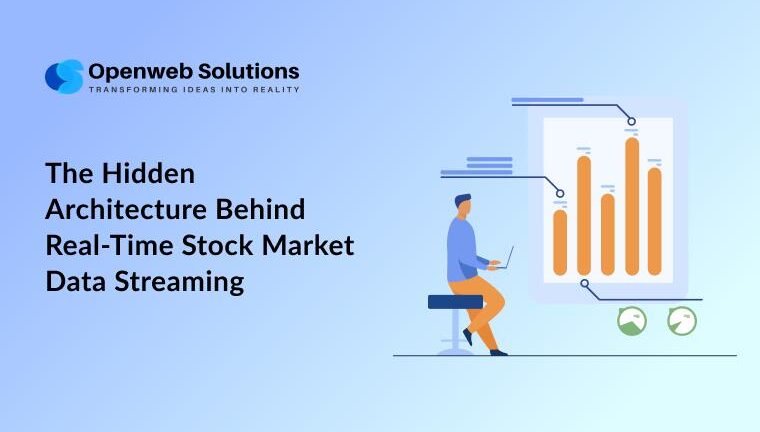
Real-time information is the backbone of today’s financial markets. Traders and investors rely on real time stock prices to make split-second decisions that can impact profits and risks. But what most users see on a screen are live charts, price ticks, alerts are only the surface layer of a highly complex system. Behind every modern trading platform lies a sophisticated architecture designed to ingest, process, secure, and deliver massive volumes of market data with near-zero latency. This blog takes you behind the scenes to explore how real-time stock market data streaming works and why the right architecture is critical for building reliable stock market software.
Table of Contents
- Why Real-Time Stock Market Data Matters
- Definition of Stock Market Streaming
- Core Components of Real-Time Data Architecture
- How Data Flows from Exchanges to Trading Platforms
- Managing Latency, Accuracy, and Scale
- Security and Reliability in Stock Data Software
- Why Architecture Choices Define Platform Success
Why Real-Time Stock Market Data Matters
In fast-moving financial markets, delays of even milliseconds can lead to missed opportunities or costly errors. Real time stock prices allow traders to track live market movements, execute trades instantly, react to volatility and news events, perform accurate technical and fundamental analysis. For brokers and financial firms, offering reliable live data is a competitive necessity. That’s why the architecture powering stock market software must be built for speed and resilience.
Definition of Stock Market Streaming
Stock market data streaming refers to the continuous flow of live market information such as price ticks, volumes, order book updates, and indices. Unlike traditional request-response systems, streaming systems push data in real time, ensuring that trading platforms receive updates instantly without repeated polling. This approach is essential for live charts, price alerts, watchlists, and automated trading logic. At scale, this becomes a highly demanding engineering challenge.
Core Components of Real-Time Data Architecture
A modern stock data software architecture includes several tightly integrated layers:
Market Data Sources
These are stock exchanges and data providers supplying live feeds. Each exchange has its own protocols, formats, and update frequencies.
Data Ingestion Layer
This layer captures raw data streams and normalizes them into a consistent internal format. It must handle high throughput and sudden traffic spikes during volatile market hours.
Processing & Aggregation Engine
Here, data is filtered, aggregated, and enriched. For example, calculating OHLC values, applying custom formulas, and preparing data for charts and indicators.
Distribution Layer
This layer streams processed data to web, desktop, and mobile trading platforms using technologies like message queues.
Storage & Caching
High-speed caches store frequently accessed data, while databases maintain historical records for analysis and reporting.
How Data Flows from Exchanges to Trading Platforms
The journey of a single price update illustrates the complexity involved:
- A trade occurs on an exchange
- The exchange broadcasts the update via a market data feed
- The ingestion layer captures and validates the data
- The processing engine applies calculations and rules
- The distribution system pushes the update instantly to users
- The trading platform displays updated prices, charts, and alerts
All of this happens in fractions of a second during active market hours.
Managing Latency, Accuracy, and Scale
Low Latency
To deliver real time stock prices, systems must minimize delays at every step. Optimized network paths, in-memory processing, and efficient protocols are critical.
High Accuracy
Incorrect data can erode trust instantly. Robust validation, error handling, and reconciliation mechanisms ensure users see accurate prices across the platform.
Scalability
Markets are unpredictable. A well-designed stock market software architecture scales during market openings, high-volatility events, and sudden spikes in user activity.
Security and Reliability in Stock Data Software
Financial data is extremely sensitive, making security a top priority. Key architectural considerations include encrypted data transmission, secure authentication and access control, redundant systems and failover mechanisms, continuous monitoring and logging. A reliable trading platform must maintain uptime even during extreme market conditions. This is achieved through distributed systems and proactive performance monitoring.
Why Architecture Choices Define Platform Success
Two trading platforms may offer similar features on the surface, but their underlying architecture determines speed of data delivery, system stability, ability to add new exchanges, and long-term maintenance costs. Custom-built stock data software allows businesses to design architectures aligned with their exact needs, whether that’s supporting multiple exchanges or thousands of concurrent users. This is why many financial firms choose custom stock market software development over generic solutions.
Build a High-Performance Trading Platform with Us
Talk to our experts to design custom stock market software that delivers accurate real time stock prices and keeps your users ahead of the market.
Conclusion
The flow of live market data that traders rely on every day is powered by a deeply complex and carefully engineered architecture. From ingesting exchange feeds to delivering real time stock prices across devices, every component must work in harmony. Understanding the hidden architecture behind stock market data streaming highlights why performance and security are non-negotiable in modern trading platforms. Businesses that invest in future-ready architectures are better positioned to deliver reliable experiences.
Frequently Asked Questions
Q1. What makes real-time stock market data streaming challenging?
Ans: High data volume, ultra-low latency requirements, exchange integration complexity, and security demands make streaming systems difficult to design and maintain.
Q2. Can off-the-shelf software handle real-time stock prices effectively?
Ans: While some can, custom stock market software offers better control and performance to specific business needs.
Q3. How do trading platforms reduce latency?
Ans: By using in-memory processing, optimized data pipelines, efficient protocols, and geographically distributed infrastructure.

Partha Ghosh is the Digital Marketing Strategist and Team Lead at PiTangent Analytics and Technology Solutions. He partners with product and sales to grow organic demand and brand trust. A 3X Salesforce certified Marketing Cloud Administrator and Pardot Specialist, Partha is an automation expert who turns strategy into simple repeatable programs. His focus areas include thought leadership, team management, branding, project management, and data-driven marketing. For strategic discussions on go-to-market, automation at scale, and organic growth, connect with Partha on LinkedIn.