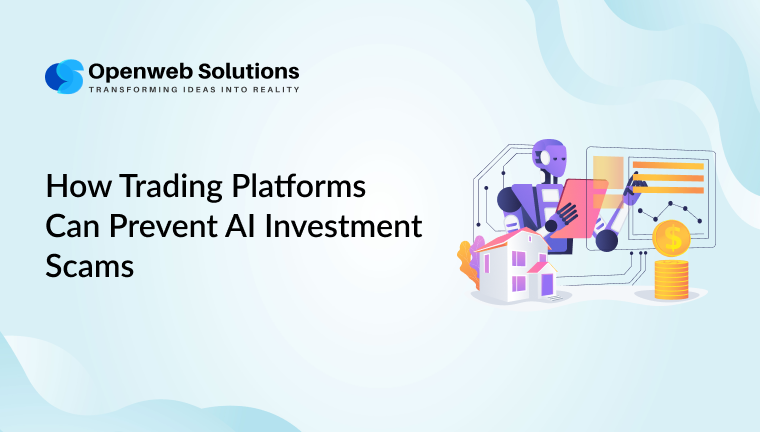
AI has changed how people trade and manage money as it has also opened a new door for fraud.
What Are AI Investment Scams?
It uses artificial intelligence to make fraudulent trading schemes look credible and automated. Victims now encounter:
- Deepfake videos of well-known investors or CEOs
- Cloned voice calls from fake financial advisors pushing a specific asset.
- AI chatbots posing as licensed brokers on fake trading platforms.
- Auto-trading bots that claim guaranteed daily returns with zero risk.
- Fake dashboards showing fabricated profit growth to encourage larger deposits.
Everyday investors often can’t tell the difference between a legitimate tool and a fraudulent one because these scams borrow the language and visuals of real AI trading platforms.
Why Trading Platforms Are a Prime Target
Trading platforms sit at the intersection of money and automation that makes them attractive to scammers in two ways. Fraudsters impersonate real platforms to steal login credentials or deposits. They build entirely fake apps that mimic the interface and marketing of established players. The platform’s reputation takes the hit when the fraud technically happened outside its own systems. This is why it must be engineered into the platform from where fintech development teams play a central role.
Core Strategies to Prevent AI Trading Scams
1. Strong Identity and Account Verification
Multi-layered KYC checks including document verification and liveness detection make it harder for scammers to create fake accounts that impersonate a platform or its users.
2. AI-Powered Fraud Monitoring
AI is also the best defense against AI trading scams. Behavioral analytics can flag unusual deposit patterns or trading activity allowing platforms to intervene before losses scale up.
3. Clear Labeling of Automated Tools
Every AI-driven feature should be clearly labeled with what it does and does not guarantee. Ambiguity is exactly what scammers exploit when they impersonate bots.
4. Domain and Brand Monitoring
Fintech development teams should actively monitor lookalike domains and cloned websites using the platform’s branding.
5. Transparent Performance Reporting
Real trading platforms should make it easy for users to verify performance data independently that reduces the impact of fake screenshots used in scams.
6. In-App Scam Education
Simple warnings before a large deposit or when a user adds a new bank account can interrupt a scam in progress and remind users that guaranteed returns are a red flag.
7. Regulatory Compliance by Design
Building to established fintech compliance standards from day one closes many of the loophole scammers rely on.
The Role of Fintech Development Teams
Preventing AI trading scams is a technical one. Fintech development teams are responsible for building the verification systems and secure architecture that make scams harder to execute in the first place. Platforms that invest in this layer of engineering early tend to spend far less time and money on damage control later.
Build a Trading Platform Users Can Trust
We help fintech businesses design secure and scalable stock market software from real-time fraud monitoring to full-scale trading platform development.
Get in touch with our team
Conclusion
AI investment scams are more convincing as generative AI improves. The platforms that stay ahead will be the ones that treat fraud prevention as a core part of product design.
Strong verification and ongoing user education together form the backbone of a trading platform people can trust.
FAQs
1. What are the warning signs of an AI trading scam?
Guaranteed or unusually high daily returns and dashboards showing profit that can’t be withdrawn are all common red flags.
2. Can AI actually help prevent trading fraud?
The same AI techniques used to power trading platforms can be used to flag suspicious accounts and transactions in real time.
3. How can users verify that a trading platform is legitimate?
Check for regulatory registration with the relevant financial authority and confirm the app is downloaded from an official app store listing.
4. What should a fintech company do if scammers clone its platform?
Report the fake domain or app for takedown immediately and work with a fintech development partner to add monitoring systems.

Partha Ghosh is the Digital Marketing Strategist and Team Lead at PiTangent Analytics and Technology Solutions. He partners with product and sales to grow organic demand and brand trust. A 3X Salesforce certified Marketing Cloud Administrator and Pardot Specialist, Partha is an automation expert who turns strategy into simple repeatable programs. His focus areas include thought leadership, team management, branding, project management, and data-driven marketing. For strategic discussions on go-to-market, automation at scale, and organic growth, connect with Partha on LinkedIn.