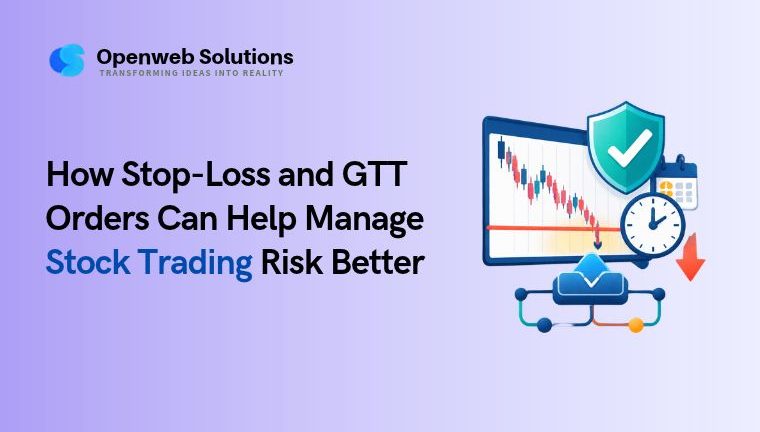
Stock market trading offers opportunities to generate returns as every trade involves a certain level of risk. Market volatility and emotional decisions can lead to significant losses if traders do not follow a proper risk management strategy. This is where automated order types such as stop-loss and GTT orders become useful.
Stop loss order in stock market trading helps traders limit potential losses by automatically triggering an exit when a stock reaches a predetermined price. Understanding these tools can help traders make more disciplined decisions and manage market exposure effectively.
Table of Contents
What Is a Stop-Loss Order?
A stop-loss order is a trading instruction designed to limit potential losses in an existing position. Traders set a specific trigger price when the order is activated according to the selected order type and broker execution rules. Suppose a trader purchases shares of a company at ₹500. The trader sets a stop-loss trigger at ₹475. Execution is not always guaranteed at the trigger price.
Understanding GTT Order Meaning
The GTT order meaning refers to an order facility offered by certain stockbrokers. It allows traders to define a trigger price and associated order details that remain active until the trigger condition is met. GTT functionality varies across brokers. A triggered order may still need to be placed with the exchange and is not necessarily guaranteed to execute.
How the Trailing Stop Loss Works
A trailing stop loss is a dynamic risk management technique in which the stop-loss level moves in the favorable direction as the stock price rises. It helps traders protect accumulated gains while allowing profitable positions to continue running. Traders should check whether their broker supports automated trailing stops or requires manual adjustments.
Stop-Loss vs. GTT vs. Bracket Order
| Order Type | Primary Purpose |
|---|---|
| Stop-loss order | Limits potential losses |
| GTT order | Executes a conditional instruction when a trigger is reached |
| Trailing stop loss | Adjusts the stop level as prices move favorably |
| Bracket order | Combines an entry with predefined target and stop-loss exits |
A bracket order is particularly useful for intraday traders who want to define both profit targets and potential losses when entering a trade. Availability and supported features depend on the broker.
Benefits of Using These Orders for Risk Management
Risk management trading practices are essential for protecting capital and maintaining consistency. Stop-loss and GTT orders offer several practical advantages.
- Better capital protection:
Predefined exit levels help traders control how much they are willing to risk in a position.
- Reduced emotional trading:
Automated instructions can reduce impulsive decisions caused by sudden market movements.
- Time efficiency:
Traders do not need to monitor every stock continuously to respond to predefined price conditions.
- Improved trading discipline:
Consistent use of entry and risk parameters encourages a structured trading approach.
Best Practices for Managing Trading Risk
Traders should follow a few important practices:
- Set stop-loss levels according to price volatility and trading strategy.
- Avoid placing stop-loss orders too close to normal market fluctuations.
- Calculate position size before entering a trade.
- Understand the difference between trigger prices and actual execution prices.
- Never assume that automated orders eliminate all trading risks.
Build Smarter Trading Solutions with Openweb Solutions
We provide stock market software development services designed to support modern trading requirements. Visit us to explore customized stock market software development solutions and discuss your project requirements.
Conclusion
Managing stock market risk requires more than identifying profitable opportunities. Traders must also plan how to protect their capital when markets move against their expectations. A stop-loss order in stock market trading and bracket orders can help create a more disciplined trading approach. Investors and traders can monitor market movements and make more informed decisions.
Frequently Asked Questions
1. What is a stop-loss order in stock market trading?
It is an instruction that activates an exit order when a stock reaches a specified trigger price to help traders limit potential losses.
2. What is the GTT order meaning in stock trading?
GTT allows traders to set conditional buy or sell instructions that remain active until triggered or expired according to broker policies.
3. Is trailing stop loss better than regular stop loss?
Trailing stop loss adjusts with favorable price movements to help protect profits. A regular stop-loss generally remains at its predefined level unless manually modified.
4. What is the difference between a GTT order and a bracket order?
A GTT order is a conditional order facility as a bracket order combines an entry order with predefined stop-loss and target exits.

Partha Ghosh is the Digital Marketing Strategist and Team Lead at PiTangent Analytics and Technology Solutions. He partners with product and sales to grow organic demand and brand trust. A 3X Salesforce certified Marketing Cloud Administrator and Pardot Specialist, Partha is an automation expert who turns strategy into simple repeatable programs. His focus areas include thought leadership, team management, branding, project management, and data-driven marketing. For strategic discussions on go-to-market, automation at scale, and organic growth, connect with Partha on LinkedIn.