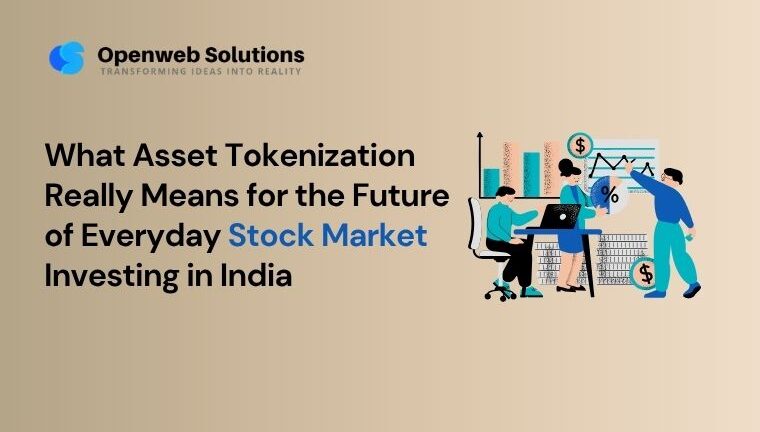
India’s stock market has become accessible through online brokerage platforms and digital investment services. Another technological development could reshape how people own and trade financial assets is asset tokenization. The concept combines blockchain technology with traditional investments to make financial markets more efficient and accessible. Asset tokenization stock market India discussions are gaining importance as financial institutions explore new digital infrastructure.
Table of Contents
What Is Asset Tokenization?
It is the process of representing ownership rights or financial interests in an asset as digital tokens recorded on a blockchain or similar distributed ledger. These tokens can represent interests in stocks, bonds, investment funds, real estate, and other assets. Its rights depend on the legal structure and the arrangements governing the investment. This illustrates how tokenization could broaden investment access without changing the underlying asset’s fundamental economic value.
How Does Tokenization Work in Stock Markets?
Traditional stock transactions involve exchanges, brokers, clearing corporations, and depositories. Tokenization introduces blockchain-based records that can represent securities or related investment interests. The process generally involves three steps:
- Digital representation :The issuer or an authorized intermediary establishes tokens representing specified ownership rights or financial interests.
- Blockchain recording: Transactions and token balances are recorded on a distributed ledger to create a traceable transaction history.
- Transfer and settlement: Eligible participants transfer tokens under the platform’s rules to use automated processes to coordinate payment and asset delivery.
Benefits for Everyday Indian Investors
Lower barriers to participation
Tokenization could make certain high-value investments accessible through smaller investment amounts. Fractional ownership may help retail investors diversify their portfolios without committing substantial capital to a single asset.
Potentially faster settlement
Blockchain-based systems can automate parts of transaction processing and reconciliation. This could reduce operational delays and improve the efficiency of securities settlement.
Greater transparency
Distributed ledgers can provide traceable transaction records. Authorised participants may be able to verify ownership transfers and transaction histories more efficiently.
New investment opportunities
Tokenization could support innovative investment products involving bonds and other eligible assets. These developments may eventually expand the range of investment structures available through regulated financial channels.
Challenges and Regulatory Considerations
- Regulatory clarity: Tokenized securities India must be evaluated according to the rights they represent and the applicable legal framework. Investors should not assume that every blockchain-based investment is authorized or protected like conventional listed shares.
- Cybersecurity and custody: Digital wallets, private keys, smart contracts, and platform infrastructure introduce risks. Technical vulnerabilities or compromised credentials could result in financial losses.
- Liquidity concerns: Dividing an asset into smaller units does not guarantee buyers or sellers will always be available. Some tokenized products may be difficult to sell quickly at a fair price.
- Investor protection: The legal ownership structure, dividend entitlements, voting rights, and insolvency protections must be clearly established.
The Future of Blockchain Stock Trading in India
The future of blockchain stock trading in India will depend on how effectively technological innovation works alongside established market safeguards. Brokerages and fintech companies may explore blockchain-enabled applications, automated settlement systems, and digital bond distribution. These developments could make investment platforms more efficient and responsive to investors’ needs. Tokenization is more likely to develop through carefully designed use cases and controlled implementations.
Interested in Building the Next Generation of Financial Applications?
Explore custom stock market software development and financial technology solutions with OpenWeb Solutions.
Conclusion
Asset tokenization could represent an important evolution in India’s financial markets by combining digital ownership records with blockchain-based transaction infrastructure. Potential benefits include fractional investment opportunities and streamline settlement processes. Understanding the rights attached to a token and verifying the regulatory status of its platform is essential. The real opportunity lies in adopting innovation responsibly. Tokenization could become another tool for making investment services more efficient and accessible.
FAQs
1. What is asset tokenization in the Indian stock market?
Asset tokenization represents ownership rights or financial interests in assets as digital tokens on a blockchain.
2. Is tokenized stock trading legal in India?
The answer depends on the product and its legal structure as this is not a blanket authorization to trade any digital representation of shares.
3. How can tokenization benefit retail investors?
Potential benefits include fractional investment opportunities and more efficient settlement.
4. What is the difference between tokenized securities and cryptocurrency?
Tokenized securities represent rights or interests connected to financial instruments as cryptocurrencies generally operate as digital assets.

Partha Ghosh is the Digital Marketing Strategist and Team Lead at PiTangent Analytics and Technology Solutions. He partners with product and sales to grow organic demand and brand trust. A 3X Salesforce certified Marketing Cloud Administrator and Pardot Specialist, Partha is an automation expert who turns strategy into simple repeatable programs. His focus areas include thought leadership, team management, branding, project management, and data-driven marketing. For strategic discussions on go-to-market, automation at scale, and organic growth, connect with Partha on LinkedIn.