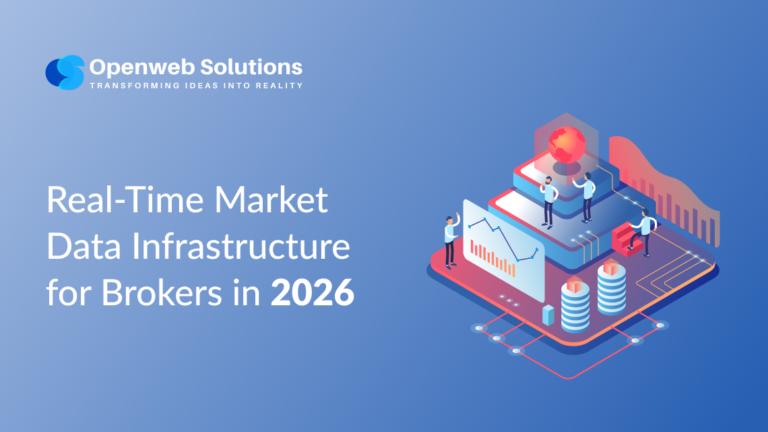
The financial markets of 2026 move at machine speed. Milliseconds determine the difference between profit and loss as brokers who lack a solid real-time market data platform are already falling behind. The infrastructure supporting your data pipeline is a competitive weapon. This blog explores what it takes to build enterprise-grade real-time market data infrastructure in 2026 and how experienced fintech development partners help brokers architect systems.
Table of Contents
Why Real-Time Market Data Infrastructure Matters
Markets across various global exchanges generate millions of data ticks every second. Traders and risk engines all need this data simultaneously with zero tolerance for latency or downtime. Several forces are making robust infrastructure more critical than ever:
- Algorithmic and AI-driven trading now account for a significant share of daily volume as these systems demand sub-millisecond data feeds.
- Retail investor growth in India has expanded the user base putting pressure on platforms to handle massive concurrent connections.
- Regulatory expectations around audit trails and risk reporting require brokers to capture.
- Multi-asset and multi-exchange access means brokers need unified data pipelines across fragmented sources.
Brokers who invest in modern real-time market data platforms gain faster execution and stronger compliance posture.
Core Components of a Real-Time Market Data Platform
A production-grade real-time market data platform for brokers in 2026 includes the following layers:
1. Market Data Feed Integration
Connecting to exchange data feeds via standard protocols. Raw tick data flows into the system from multiple sources simultaneously.
2. Low-Latency Data Normalization
Raw feed data comes in different formats from each exchange. A normalization engine standardizes this into a unified schema for analytics to stack all speaks the same language.
3. Real-Time Streaming Engine
The streaming engine broadcasts live price updates and trade confirmations to thousands of connected clients with minimal latency.
4. Market Watch & Quote Distribution
Brokers need scalable market watch systems that let traders monitor hundreds of instruments simultaneously on a single screen.
5. Price Alerting & Notification Engine
A rules-based engine that monitors live prices and triggers instant alerts via push notifications as a key feature for both retail and institutional traders.
6. Historical Data Store
A performance time-series database stores tick history for charting and regulatory reporting.
7. Charting & Technical Analysis Engine
Connecting live data to charting libraries with support for multiple chart types and indicators with the ability for traders to save custom templates.
The New Backbone of Modern Broking
AI trading platforms are transforming how brokers and their clients interact with market information in 2026. AI capabilities now embedded in brokerage platforms include:
- Predictive analytics that surface high-probability trade setups based on historical patterns and current market conditions.
- Sentiment analysis that processes news and earnings data in real time to generate sentiment scores for instruments.
- Smart order routing that AI systems use to determine the optimal execution path across exchanges to minimize slippage and maximize fill quality.
- Anomaly detection for risk management for potential margin breaches or suspicious activity in real time.
- Personalized dashboards that learn individual trader preferences and surface relevant data.
Integrating AI into a trading platform requires purpose-built data architecture and tight integration with the real-time data pipeline from day one.
Fintech Development Considerations for Brokers
Choosing the right fintech development partner and technical approach is as important as choosing the right technology stack. Brokers evaluating new platform builds or upgrades should consider the following:
- Technology Stack Choices: Modern brokerage platforms are built on microservices architectures using Java and frameworks like React or Vue.js for the frontend. Mobile clients are built with Flutter or React Native for cross-platform reach.
- Security and Compliance First: Real-time market data platforms handle sensitive financial and personal data. End-to-end encryption and detailed audit logging must be built in.
- Scalability by Design: Platforms must handle normal trading volumes and survive circuit-breaker events and IPO days where volumes spike by 10x or more. Cloud-native architectures with auto-scaling are the industry standard.
- Owning Your Intellectual Property: Brokers should ensure they receive full source code ownership with no licensing dependencies on the development partner as an approach.
How We Build Real-Time Trading Systems
We have built comprehensive trading systems for brokers and trading firms across India and internationally. Their trading platform development covers the full feature spectrum: real-time streaming quotes with fundamental and customizable stock screening with user-defined formulas.
What sets us apart is their end-to-end delivery model: from initial consultation and requirement analysis to dedicated development team assignment and full handover of proprietary source code to the client upon project completion. We offer a free consultation to assess technical requirements and match them with the right technology and team.
Build Your Real-Time Market Data Platform with Us
Talk to our stock market software specialists today for a free consultation and project quote.
Book a Free Consultation
Conclusion
Real-time market data infrastructure is a core differentiator for brokers in 2026. Platforms that deliver low-latency streaming data and user experience will win the loyalty of retail and institutional traders. Building this infrastructure requires more than off-the-shelf software. It demands experienced fintech development partners who understand the technology and the domain.
FAQs
Q1. What is a real-time market data platform?
The platform is a software system that captures and distributes live financial market data that includes prices and quotes.
Q2. How is a real-time market data platform different from a standard trading platform?
It focuses on order entry and portfolio management as a real-time market data platform that feeds live prices and trade data into the trading platform.
Q3. Which exchanges can be integrated into a broker’s real-time market data system?
We build platforms that connect to BSE and Mutual Fund data feeds with international exchange APIs where required.

Partha Ghosh is the Digital Marketing Strategist and Team Lead at PiTangent Analytics and Technology Solutions. He partners with product and sales to grow organic demand and brand trust. A 3X Salesforce certified Marketing Cloud Administrator and Pardot Specialist, Partha is an automation expert who turns strategy into simple repeatable programs. His focus areas include thought leadership, team management, branding, project management, and data-driven marketing. For strategic discussions on go-to-market, automation at scale, and organic growth, connect with Partha on LinkedIn.