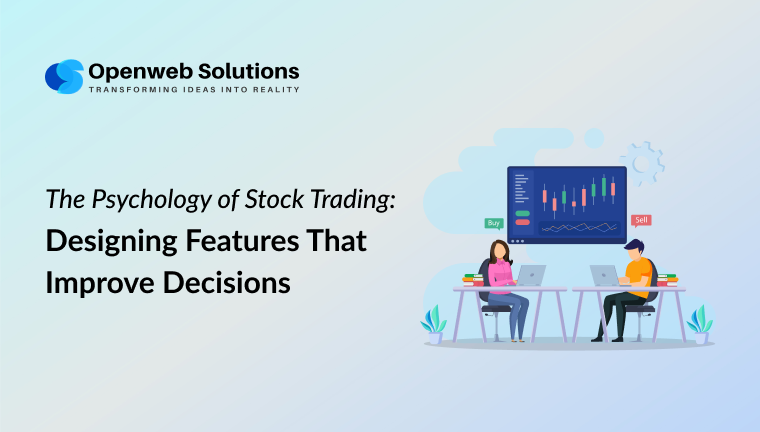
Every trader enters the market with a plan, but impulsive decisions and losses could have been avoided. What separates consistent traders from reactive ones is rarely market knowledge alone. This is where the stock trading platform you use becomes important. The best platforms are engineered around human behavior. They are designed to slow down impulsive trades and remove the mental friction that leads to poor choices. In this blog, we explore how psychology shapes trading decisions and what features must include to help users trade smarter.
Table of Contents
Why Psychology Matters in Trading
Online trading has democratized access to financial markets. Anyone with a smartphone can now buy and sell equities in real time. But accessibility comes with a challenge: when markets move fast, human instincts take over. We are wired to avoid loss more than we seek to gain and hold onto losing positions hoping for a recovery. They are predictable, documented patterns of human cognition. And a well-designed trading platform can anticipate these patterns and put friction in the right places.
Common Cognitive Biases That Hurt Traders
Understanding the enemy is the first step and here are the most destructive biases in trading psychology:
Loss Aversion — Traders feel the pain of a loss roughly twice as intensely as the pleasure of an equivalent gain.
Confirmation Bias — Traders seek out data that confirms what they already believe, ignoring signals that contradict their position.
Overconfidence Bias — A streak of wins can cause traders to overestimate their skill and take on excessive risk.
Recency Bias — A few bad sessions can make a trader overly cautious; a few wins can make them reckless.
How a Good Trading Platform Fights Cognitive Bias
A modern trading platform is an interface between the trader as great platform design subtly nudges users toward rational behavior. Friction by design to add a confirmation step before large or unusual trades creates a brief pause. Behavioral analytics for some advanced platforms track a user’s own trading patterns and surface insights. Default settings that promote discipline with pre-populating stop-loss fields by default encourage traders to think about risk before entering a position.
Key Features That Support Better Decisions
Whether you are building or choosing a trading app, these are the features that actively support psychological discipline:
- Real-Time Alerts — Price alerts ensure traders act on pre-defined triggers rather than watching a chart all day.
- Advanced Charting — Multiple graph studies with fundamental and technical analysis tools allow traders to validate a thesis.
- Custom Watchlists — The ability to filter thousands of stocks using your own technical and fundamental criteria removes the paralysis of too much choice.
- Multiple Market Watch — Seeing BSE, NSE, MCX, and currency markets enables comparative decisions.
- Historical Data Access — Reviewing how a strategy would have performed historically builds rational confidence.
- Trade Journals — Detailed trade reports help traders review their own behavior patterns, reinforcing what works.
The Role of Stock Market Analysis in Rational Trading
Stock market analysis gives traders an objective foundation for decisions. The best platforms make this analysis accessible. Fundamental analysis tools help traders understand a company’s true value, reducing the impact of short-term market sentiment. Technical analysis tools, including end-of-day charting and multiple graph studies, help identify trend patterns that are easy to miss when looking at raw price data.
A good trading app integrates these layers of analysis, so the path from insight to action is deliberate.
Designing for All Levels of Traders
One of the most important and often overlooked design principles is accessibility across skill levels. A platform that only serves experienced traders excludes a growing segment of retail investors. The ideal stock trading platform is layered where beginners get clean interfaces, and advanced users unlock deeper customization and multi-screen configurations. This approach ensures that the platform supports better decisions rather than creating confusion or boredom.
Build a Smarter Trading Platform with Us
We combine deep domain expertise in stock market software with development across web and mobile. Let us help you!
Conclusion
The stock market rewards discipline, and it is much easier when your trading platform is designed to work with your psychology. The right trading app can be the difference between a reactive trader and a rational one. We specialize in building stock market software that is engineered from the ground up with functionality and user behavior in mind. With 12+ years of experience developing online trading platforms across the web and mobile, we build software that is powerful.
Thank you for reading.
FAQs
Q1. What makes a trading platform psychologically effective?
An effective trading platform includes features like pre-trade confirmation prompts, real-time alerts, clean UI design, and trade journaling tools.
Q2. How does stock market analysis help reduce emotional trading?
Stock market analysis gives traders objective, data-backed reasons for entering or exiting a position.
Q3. Can a trading app be built to support beginners and experts alike?
Yes, a well-designed trading app uses a layered interface for beginners, with deep customization and advanced tools for experienced traders.

Partha Ghosh is the Digital Marketing Strategist and Team Lead at PiTangent Analytics and Technology Solutions. He partners with product and sales to grow organic demand and brand trust. A 3X Salesforce certified Marketing Cloud Administrator and Pardot Specialist, Partha is an automation expert who turns strategy into simple repeatable programs. His focus areas include thought leadership, team management, branding, project management, and data-driven marketing. For strategic discussions on go-to-market, automation at scale, and organic growth, connect with Partha on LinkedIn.