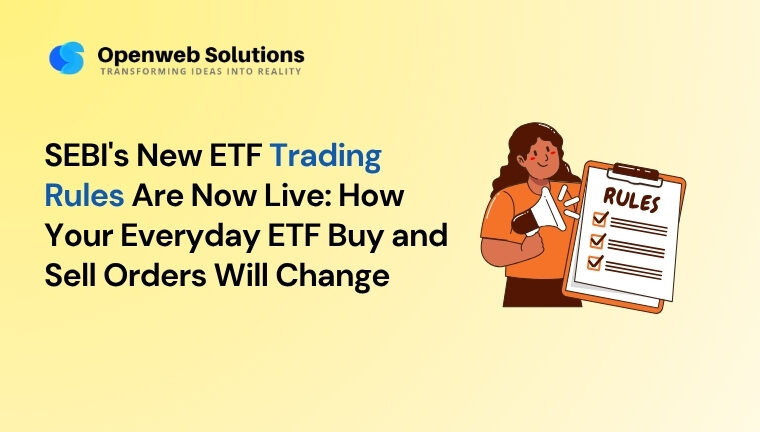
ETFs have become an accessible way for Indian investors to gain exposure to equities and other asset classes. But the way ETFs trade on stock exchanges has changed significantly. The SEBI introduced a revised framework covering ETF base prices and close-out procedures. These changes can affect how buy and sell orders behave during volatile markets and at the beginning of a trading session.
Table of Contents
What Has Changed Under SEBI’s New ETF Rules?
The SEBI new ETF rules 2026 introduce a revised trading framework designed to make ETF price limits more responsive to actual market conditions. ETFs generally operated with a fixed 20% price band based on the ETF’s T-2-day NAV. SEBI has now moved toward a more responsive framework using recent trading prices and dynamic bands for several ETF categories. The key changes include:
- A revised base-price calculation
- Dynamic price bands for equity and debt ETFs
- Dynamic bands for gold and silver ETFs
- A pre-open call auction for commodity ETFs
- Revised close-out rules for Overnight and Liquid ETFs
- Synchronization of ETF price-band changes across exchanges
A New Way to Calculate ETF Base Prices
The base price is important because it determines the permitted trading range for an ETF.
The initial base price is the ETF’s T-1 day closing price during the final 30 minutes of trading.
The day’s LTP is used if there is no trading during those final 30 minutes. The latest available closing NAV becomes the base price. Corporate actions are also taken into account when adjusting the base price. SEBI has also indicated that exchanges and AMCs should work toward using the T-1 closing NAV as the base price.
ETF Dynamic Price Bands Explained
One of the most significant changes is the introduction of dynamic price bands. The initial price band is ±10%. A cooling-off period applies before the band can be widened. The band can then be expanded by 5 percentage points with the expansion occurring in the direction of the price movement. This means investors may encounter situations where an order cannot execute at a price beyond the currently applicable band until the exchange widens it.
What Changes for Gold and Silver ETFs?
Gold and silver ETFs now have their own dynamic framework. Their initial price band is ±6% with the possibility of widening 3 percentage points after a cooling-off period. Exchanges may relax the limits further in stages. Another important change is the introduction of a pre-open call auction for commodity ETFs. This mechanism is intended to support more orderly price discovery when domestic trading begins.
How Real-Time ETF Pricing in India Could Improve
The revised framework is particularly relevant to real-time ETF pricing India. An ETF’s exchange price can trade at a premium or discount to its underlying value. SEBI’s framework seeks to make permitted trading ranges more responsive to current market conditions. This also highlights the importance of displaying timely information such as:
- Live ETF market price
- Bid and ask prices
- Trading volume
- Applicable price bands
- Order status
- Market alerts
What Investors Should Know Before Placing Orders
The new rules do not change the fundamental purpose of an ETF. Investors still need to evaluate the underlying index or asset. The mechanics of placing an order can matter more during volatile sessions. Investors should pay attention to the current price band and consider using orders when appropriate.
Conclusion
The SEBI new ETF rules 2026 represent a significant change in how ETFs are priced and traded on Indian exchanges. From T-1 market-based reference prices to ETF dynamic price bands and pre-open auctions for gold and silver ETFs. Understanding these changes can help them interpret why an ETF order may behave differently during volatile periods.
Looking to Build a Stock Market Trading Platform?
Openweb Solutions develops customized stock market software with real-time market data integration.
Contact our team now
FAQs
1. What is ETF dynamic price bands?
Dynamic price bands allow the permitted trading range of certain ETFs to widen progressively when prices approach the initial limit.
2. What is the new base price for ETFs?
The initial base price is the T-1 day’s closing price is based on the last 30 minutes’ VWAP if there is insufficient trading.
3. Are gold and silver ETFs affected?
Gold and silver ETFs now have dynamic price bands starting at ±6% with a pre-open call auction intended.
4. Will the new rules change ETF investment objectives?
The rules primarily change the trading and price-discovery framework as investors should still evaluate.

Partha Ghosh is the Digital Marketing Strategist and Team Lead at PiTangent Analytics and Technology Solutions. He partners with product and sales to grow organic demand and brand trust. A 3X Salesforce certified Marketing Cloud Administrator and Pardot Specialist, Partha is an automation expert who turns strategy into simple repeatable programs. His focus areas include thought leadership, team management, branding, project management, and data-driven marketing. For strategic discussions on go-to-market, automation at scale, and organic growth, connect with Partha on LinkedIn.