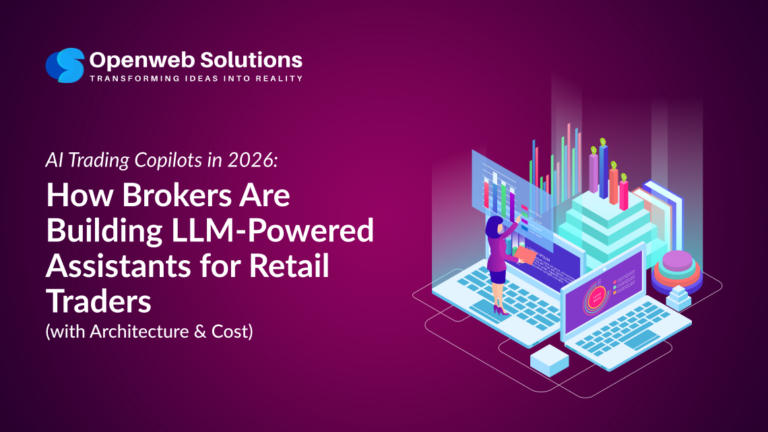
The retail trader of 2026 doesn’t scroll through five tabs of charts and screeners anymore. They ask a question. “What’s driving Nifty’s move today?” Or “Should I hold my HDFC Bank position given today’s RBI statement?” Brokers across India and globally are already deep into AI trading copilot development to embedd LLM assistants directly into their trading platforms. You are already behind if you’re a broker or trading software development firm that hasn’t started architecting one.
Table of Contents
Why 2026 Is the Inflection Year
Two things converged this year to make the LLM trading viable at scale with inference costs and model capabilities. Running GPT-4-class models in 2023 cost roughly $30–60 per million output tokens that might trigger dozens of queries per session. Distilled and quantized purpose-trained on financial corpora have brought that number down to $1–3 per million tokens. A conversational trading session now costs less than a rupee to serve. Models have gotten good at financial reasoning to read earnings transcripts as the retail trading AI has crossed from novelty to utility.
What a Trading Copilot Actually Does
These assistants sit beside the trader and amplify their judgment. Core capabilities of a well-built trading interface include:
- Market Explainability — Translating live price action and news into plain-language summaries to the user’s holdings
- Portfolio Q&A — “What’s my sector concentration risk?” answered instantly from live portfolio data
- Screener Conversations — “Show me mid-cap IT stocks that broke out on volume this week”
- Alert Narration — The copilot explains why the alert matters in current market context
- Trade Journaling — Automatically tagging and summarizing completed trades for post-session review
The Architecture Behind the Magic
Building a production-grade AI trading development stack involves five layers working in concert:
1. Data Ingestion Layer
Real-time market feeds and the user’s portfolio database are normalized into a structured context store. Latency here must stay under 200ms is dangerous in a live market.
2. RAG Engine
The copilot cannot hold all market knowledge in its weights. A vector database stores embeddings of recent news and historical chart patterns. The top-k relevant documents are retrieved and injected into the LLM prompt.
3. LLM Reasoning Core
Most production systems in 2026 use a hybrid small model for routine queries to a full-size frontier model for complex multi-step reasoning. Fine-tuning on Indian market terminology improves relevance.
4. Tool Use / Function Calling Layer
The LLM is given structured tools to incorporate the result into its response. This is what separates a genuine LLM trading assistant from a glorified chatbot.
5. Guardrail and Compliance Layer
SEBI regulations are explicit as software cannot provide investment advice without licensing. Every response route through a guardrail model that flags and softens anything that crosses into regulated advice territory.
What Does It Cost to Build?
Realistic build estimates in 2026 look like this for a mid-size brokerage integrating a trading copilot into an existing platform:
| Component | Estimated Cost (INR) |
|---|---|
| RAG pipeline + vector DB setup | ₹3–6 Lakhs |
| LLM fine-tuning on financial corpus | ₹4–8 Lakhs |
| Tool calling integration (live feeds) | ₹2–4 Lakhs |
| UI (trading interface) | ₹3–5 Lakhs |
| Compliance guardrail layer | ₹1–3 Lakhs |
| Total (MVP) | ₹13–26 Lakhs |
Monthly inference and API costs for a 50,000-user base run approximately ₹80,000–1.5 Lakhs depending on usage intensity.
The Broker Opportunity
The brokerages winning the retail trader market in 2026 are the ones that make complex markets feel simple. A well-built conversational trading interface reduces the cognitive load that causes retail traders to exit platforms and close accounts. This is the natural next frontier for trading software development firms with deep expertise in platforms supporting BSE and mutual funds. The infrastructure is already in place with an LLM reasoning layer on top of that stack is an upgrade. The retail traders want someone who understands the data to talk to them.
Build Your AI Trading Copilot with Us
We have been building stock market software since 2010, covering BSE and more. We now integrate LLM-powered copilots into existing trading platforms without requiring a full rebuild. Our team handles architecture and UI whether you need an MVP in 8 weeks or a full-scale production rollout.
Book a Free Consultation →
FAQs
Q1. What exactly is an AI trading copilot?
It executes orders automatically based on pre-programmed rules to answer questions and narrates alerts in plain language.
Q2. Is it legal to deploy an LLM trading in India under SEBI rules?
Yes! SEBI regulations restrict personalized investment advice to licensed entities as educational clearly disclaims that outputs are not financial advice.
Q3. How long does it take to build an AI trading copilot for MVP?
A functional MVP covering market Q&A and screener conversations takes 8–12 weeks for a brokerage with an existing trading platform.

Partha Ghosh is the Digital Marketing Strategist and Team Lead at PiTangent Analytics and Technology Solutions. He partners with product and sales to grow organic demand and brand trust. A 3X Salesforce certified Marketing Cloud Administrator and Pardot Specialist, Partha is an automation expert who turns strategy into simple repeatable programs. His focus areas include thought leadership, team management, branding, project management, and data-driven marketing. For strategic discussions on go-to-market, automation at scale, and organic growth, connect with Partha on LinkedIn.