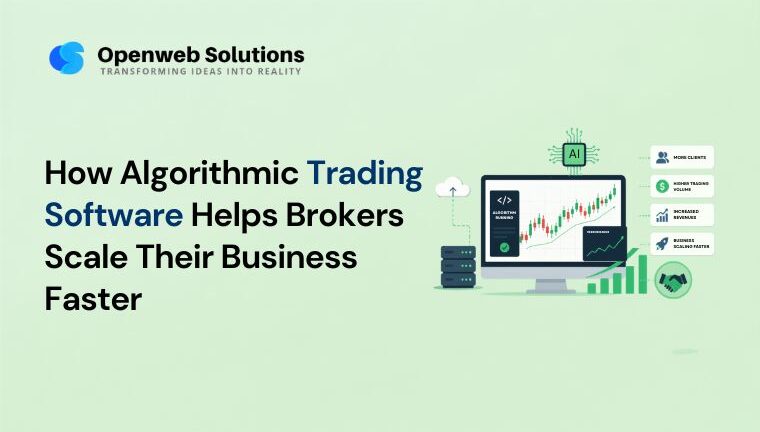
The financial trading industry has evolved rapidly with technology becoming the driving force behind faster execution and improved client experiences. Brokers need innovative solutions to stay competitive. One such solution is algorithmic trading software. Algorithmic trading systems eliminate manual intervention and enable brokers to handle larger trading volumes without expanding operational costs.
Investing in advanced algo trading software can accelerate business growth while enhancing customer satisfaction. In this blog, we’ll explore how algorithmic trading solutions empower brokers to scale faster and why they have become an essential part of modern financial markets.
Table of Contents
What Is Algorithmic Trading Software?
It is a technology platform that uses predefined trading strategies and market conditions to execute buy and sell orders automatically. The software continuously monitors market data and places trades within milliseconds whenever specific conditions are met.
Modern trading platforms also integrate real-time market data, technical indicators, risk management tools, portfolio monitoring, multi-exchange connectivity, and automated order execution. Brokers can execute thousands of trades efficiently while minimizing human errors and emotional decisions by leveraging automated trading.
Why Brokers Need Algorithmic Trading Software
Today’s financial markets operate around the clock with massive trading volumes generated every second. Manual trade execution simply cannot keep up with the speed and complexity of modern markets. Here’s why brokers are increasingly adopting algorithmic solutions:
Faster Trade Execution
Milliseconds often determine profitability in financial markets. Algorithmic systems execute trades instantly based on predefined conditions to help brokers capture market opportunities before competitors.
Increased Trading Capacity
Brokers can process thousands of simultaneous transactions using algo trading software to allow them without increasing workforce requirements.
Reduced Operational Costs
Automation minimizes repetitive manual tasks to reduce staffing costs while improving operational efficiency. This enables brokerage firms to allocate resources toward customer acquisition and business development.
Key Benefits of Algorithmic Trading Software
1. Improved Accuracy
Human errors such as incorrect pricing or emotional trading decisions can negatively impact profitability. Algorithmic trading software follows predefined rules consistently to ensure greater precision and reliability.
2. Real-Time Market Monitoring
Algorithmic systems continuously monitor stock prices, technical indicators, market volatility, trading volumes, and economic events. The software reacts instantly to changing market conditions to enable faster decisions than manual processes.
3. Scalability Without Complexity
Manual processes become difficult to manage. Automated trading platforms allow brokers to expand operations without significantly increasing operational overhead. Algorithmic systems maintain consistent performance.
4. Multi-Exchange Integration
Modern brokerage businesses often support trading across multiple exchanges and asset classes. Algorithmic trading platforms can integrate with stock exchanges, commodity markets, currency markets, derivatives, and mutual funds. This flexibility enables brokers to offer a wider range of investment opportunities through a single platform.
Choosing the Right Development Partner
Successful implementation depends on choosing an experienced software development partner.
A reliable development company should offer custom software development, exchange API integration, scalable architecture, secure infrastructure, ongoing technical support, regular maintenance, UI/UX optimization, and cloud deployment expertise. Partnering with experienced developers ensures your trading platform remains secure and adaptable to changing market conditions.
Ready to transform your brokerage business?
Openweb Solutions specializes in developing secure and feature-rich trading platforms to your business goals. Our experienced development team can help you build a high-performance platform that drives growth and enhances client satisfaction.
Contact us today
Conclusion
Brokers need technology that enables faster execution and sustainable growth. Algorithmic trading software has become a strategic investment for brokerage firms looking to automate operations and scale their services without compromising performance. Modern algo trading software empowers brokers to deliver exceptional trading experiences while expanding their business. Firms can stay ahead of market demands and build a future-ready brokerage platform capable of supporting long-term success.
FAQs
1. What is algorithmic trading software?
It is a platform that automatically executes trades based on predefined strategies and trading rules without requiring manual intervention.
2. How does algo trading software benefit brokers?
It improves execution speed and enables brokers to scale their businesses efficiently.
3. Is automated trading suitable for small brokerage firms?
Yes. Modern automated trading platforms are scalable and can be customized to meet the needs of startups and enterprise-level financial institutions.
4. Can algorithmic trading software integrate multiple exchanges?
Yes. Most modern platforms support integration with multiple stock and derivatives exchanges through secure APIs.
5. What should brokers consider before investing in algorithmic trading software?
Brokers should evaluate scalability and the expertise of the software development partner before making an investment.

Partha Ghosh is the Digital Marketing Strategist and Team Lead at PiTangent Analytics and Technology Solutions. He partners with product and sales to grow organic demand and brand trust. A 3X Salesforce certified Marketing Cloud Administrator and Pardot Specialist, Partha is an automation expert who turns strategy into simple repeatable programs. His focus areas include thought leadership, team management, branding, project management, and data-driven marketing. For strategic discussions on go-to-market, automation at scale, and organic growth, connect with Partha on LinkedIn.