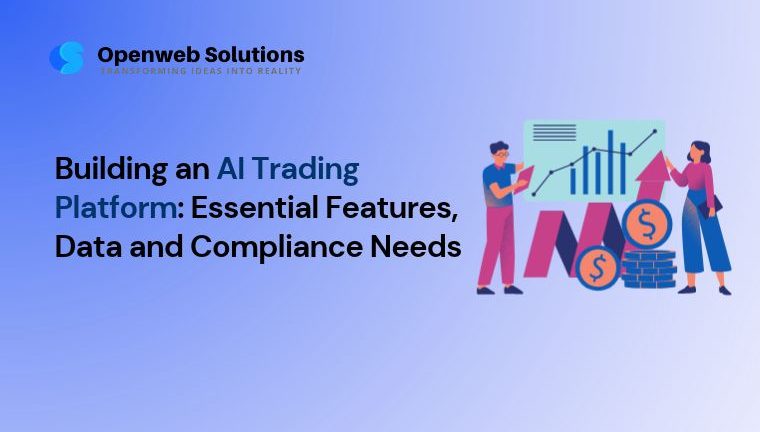
Artificial intelligence is transforming how traders analyze financial markets and manage investment risks. AI-powered solutions help financial businesses process large volumes of market information and make data-driven decisions. Building a reliable trading solution requires more than integrating a machine learning model. Successful AI trading software development involves combining intelligent algorithms and regulatory compliance. Understanding these requirements is essential before investing in an AI-powered trading platform.
Table of Contents
What Is an AI Trading Platform?
An AI trading platform is a software solution that uses artificial intelligence and data analytics to support financial market analysis and trading activities. AI-powered platforms can analyze historical data and adapt models as new information becomes available. Businesses investing in AI trading platform development can build customized solutions for stock analysis and automated trading workflows.
Essential Features of an AI Trading Platform
A successful platform should combine intelligent functionality with a user-friendly trading experience.
Real-Time Market Data Integration
Access to accurate stock prices and historical information is essential. Integration with authorized market data providers helps ensure timely and reliable analysis.
AI-Powered Market Prediction
Machine learning models can analyze historical price movements and market patterns to estimate potential price trends. Predictions should include appropriate confidence measures rather than guarantees.
Algorithmic Trading Engine
An integrated engine can execute predefined trading strategies based on signals and risk parameters. This is where AI insights can be combined with automated trading rules.
Portfolio and Risk Management
Features such as exposure monitoring and portfolio diversification support better risk control.
Automated Alerts and Reporting
Custom notifications and trading summaries help users monitor platform activity and make informed decisions.
Role of Data and Machine Learning in Stock Trading
Data is the foundation of effective AI trading applications. The quality and availability of information directly influence model performance. Machine learning in stock trading uses this information to identify patterns that may not be immediately visible through conventional analysis.
Supervised learning models can identify relationships between market indicators and historical price movements. Deep learning techniques can analyze sequential market data as NLP can extract sentiment from financial news. Developers must also account for transaction costs and change market conditions to reduce misleading results.
Compliance and Security Requirements
Financial software must prioritize security and applicable regulatory requirements. Important considerations include:
Regulatory compliance
Follow applicable SEBI and other jurisdiction-specific requirements on the platform’s business model.
Data protection
Encrypt sensitive information during transmission and storage.
User authentication
Implement secure login and role-based access controls.
Audit trails
Maintain records of trading decisions and order execution.
Model governance
Monitor model accuracy and performance changes over time.
Steps to Develop an AI Trading Platform
A structured development process helps reduce technical and operational risks.
Integrate market data
Establish reliable connections with authorized financial data providers.
Develop AI models
Build and validate models using relevant historical and real-time information.
Implement trading functionality
Integrate strategy execution, risk controls, dashboards, and reporting.
Test and deploy
Conduct security assessments, performance testing, and controlled deployment.
Monitor and optimize
Continuously evaluate system performance and retrain models when justified.
Ready to Build Your AI-powered Trading Platform?
Contact Openweb Solutions to discuss your project requirements and explore customized stock market software development solutions.
Conclusion
Building an effective AI-powered trading solution requires the right combination of machine learning and regulatory awareness. Every component must work together to deliver a secure and dependable user experience. We offer custom stock market software development services for businesses seeking financial technology solutions. Choosing the right development approach is the first step toward building a competitive product.
Frequently Asked Questions
Q1. What is AI trading software development?
It is the process of building trading applications that use artificial intelligence and machine learning for market analysis and automated trading workflows.
Q2. How is machine learning used in stock trading?
Machine learning analyzes historical and real-time financial data to identify patterns and support investment decisions.
Q3. What data is required to build an AI trading platform?
Typical requirements include historical prices, live market feeds, trading volumes, company financial data, economic indicators, and relevant financial news.
Q4. Is AI trading software suitable for brokerage firms?
Brokerage firms can use AI-powered solutions for market analysis and broker-integrated automated workflows to applicable regulations.
Q5. How long does it take to develop an AI trading platform?
Development time depends on platform complexity integrations as a basic analytical application generally requires less time than a full brokerage-integrated platform.

Partha Ghosh is the Digital Marketing Strategist and Team Lead at PiTangent Analytics and Technology Solutions. He partners with product and sales to grow organic demand and brand trust. A 3X Salesforce certified Marketing Cloud Administrator and Pardot Specialist, Partha is an automation expert who turns strategy into simple repeatable programs. His focus areas include thought leadership, team management, branding, project management, and data-driven marketing. For strategic discussions on go-to-market, automation at scale, and organic growth, connect with Partha on LinkedIn.