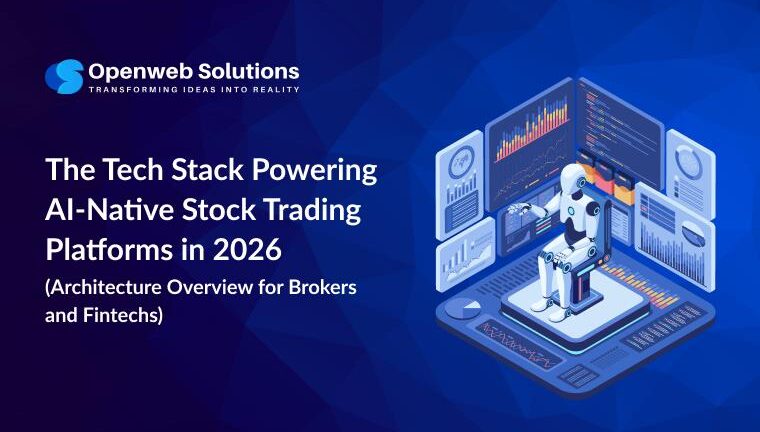
In 2026, the difference between a broker that retains clients and one that hemorrhages them often comes down to a single question: how modern is your platform architecture? AI trading platform development has crossed the threshold from competitive advantage to table stakes. Brokers and fintechs that are still running monolithic, legacy codebases are actively losing ground to platforms that can execute smarter, scale faster, and personalize better. This blog breaks down the modern trading platform tech stack that is powering the most capable AI-native systems today.
Table of Contents
- Why Architecture Matters More Than Ever
- Layer 1: The Data Ingestion and Streaming Engine
- Layer 2: The AI and ML Inference Layer
- Layer 3: Trading Architecture
- Layer 4: The Frontend and Mobile Experience
- Layer 5: Security, Compliance, and Audit
- Book a Free 45-Minute Architecture Scoping Call
- Conclusion
- Frequently Asked Questions
Why Architecture Matters More Than Ever
A trading platform must handle extreme data velocity, guarantee near-zero latency on order execution, comply with SEBI, NSE, BSE, and MCX regulatory frameworks, and increasingly, run AI inference models in real time. Getting any single layer wrong creates cascading failures. A slow data pipeline kills your AI engine. A poorly designed order management system nullifies your charting intelligence.
Layer 1: The Data Ingestion and Streaming Engine
Every AI-native platform starts with data, volume, speed, and cleanliness of that data determines the quality of every downstream signal. The modern standard is an event-driven streaming architecture built on Apache Kafka or AWS Kinesis. These tools ingest real-time market feeds from exchanges like NSE and BSE via FIX protocol or WebSocket connections, normalize tick data, and push it downstream to AI models. For custom broker trading platform development, this layer is where most teams underinvest early on.
Layer 2: The AI and ML Inference Layer
This is where the modern trading platform earns its intelligence and the AI layer comprises three distinct workloads:
Predictive models
LSTMs, transformer-based time-series models, and gradient boosting algorithms trained on historical OHLCV data, options chain data, and alternative datasets.
Real-time NLP engines
Sentiment analysis pipelines that process financial news, BSE/NSE announcements, and social signals using fine-tuned LLMs.
Anomaly detection models
Models that flag unusual order patterns, detect volatility spikes, and trigger circuit-breaker logic before positioning spiral out of control.
Running inference at scale requires GPU-backed compute paired with a low-latency feature store, so models always access fresh features rather than recomputing raw data on every request.
Layer 3: Trading Architecture
The backbone of a resilient, scalable trading platform today is a cloud-native trading architecture built on microservices, containers, and Kubernetes orchestration. Key infrastructure components include:
- API Gateway — Manages routing, rate limiting, and authentication across services
- Service mesh — Handles inter-service communication, observability, and failover
- Redis / Memcached — In-memory caching for market watch lists, session data, and frequently queried aggregates
- Elasticsearch — Powers fast search across instruments, historical trades, and audit logs
Layer 4: The Frontend and Mobile Experience
The modern trader interface is built on React or Next.js for web, with Flutter or React Native powering cross-platform mobile applications. Real-time price streaming to the UI goes through WebSocket connections managed via libraries like Socket.IO, keeping charts and ordering books live without page refreshes.
Layer 5: Security, Compliance, and Audit
In 2026, this means end-to-end TLS encryption, OAuth 2.0 / multi-factor authentication, SEBI-compliant audit trails stored in immutable logs, and automated KYC/AML checks integrated via third-party APIs. Role-based access control differentiates between retail traders, sub-brokers, RMs, compliance officers, and platform admins.
Book a Free 45-Minute Architecture Scoping Call
If you are a broker, sub-broker, or fintech founder planning a trading platform whether a greenfield build or an AI layer on top of an existing system, the most valuable 45 minutes you can spend is a scoping conversation before a budget is committed.
Conclusion
The modern trading platform tech stack is an architecture you engineer with deliberate decisions at every layer. For brokers and fintechs planning a new build or a platform overhaul, partnering with a team that has deep domain experience in financial systems and cloud-native engineering is the most reliable path to a platform that performs under real market conditions. We have been building stock market software and trading applications since 2010, using J2EE, PHP, and modern cloud-native frameworks.
Thank you for reading.
Frequently Asked Questions
Q1. What’s the difference between a 2022-era and a 2026 AI-native trading platform?
A 2022-era platform was largely reactive that displayed market data, executed orders, and offered basic charting. The core architecture was monolithic or lightly modularized, with batch-processing analytics running overnight.
Q2. What cloud provider is best for low-latency trading in India?
For most Indian trading platforms, AWS Mumbai is the leading choice. Its physical proximity to NSE’s colocation facility in Mahape, Navi Mumbai gives it a measurable round-trip latency advantage. AWS also offers the broadest selection of managed services for Kinesis for streaming, and Aurora for databases.
Q3. Which open-source components are production-ready for trading platforms?
The open-source ecosystem for trading infrastructure has matured considerably. Components that are genuinely production-ready in 2026 include Apache Kafka, Apache Flink, Feast, Lightweight Charts, and OpenTelemetry.

Partha Ghosh is the Digital Marketing Strategist and Team Lead at PiTangent Analytics and Technology Solutions. He partners with product and sales to grow organic demand and brand trust. A 3X Salesforce certified Marketing Cloud Administrator and Pardot Specialist, Partha is an automation expert who turns strategy into simple repeatable programs. His focus areas include thought leadership, team management, branding, project management, and data-driven marketing. For strategic discussions on go-to-market, automation at scale, and organic growth, connect with Partha on LinkedIn.