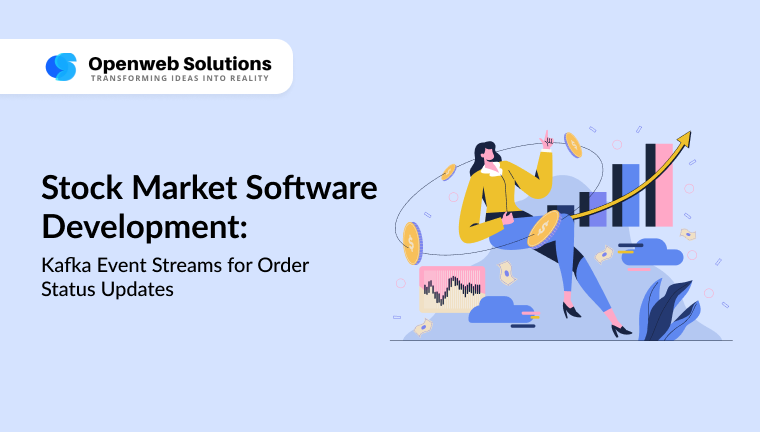
Real time order status is the heartbeat of a trading platform. Your users want instant confirmation that an order is accepted, routed, partially filled, fully filled, canceled, or rejected. Your risk engine needs the same information to keep exposure within limits. In this guide, we dive into how event streams help teams deliver precise and timely updates at scale, and why Apache Kafka is a proven backbone for modern trading stacks. If you are leading stock market software development, this playbook shows you how to design topics, producers, consumers, and schemas so every status change is captured, processed, and displayed without guesswork.
Why order status updates are hard in stock market software development
The hard parts are not only about speed. They are about correctness, traceability, and graceful failure.
- Burst traffic during market open and close creates sudden spikes that punish databases and web sockets.
- Multi venue routing means the same parent order may fan out to several child orders with different lifecycles.
- Partial fills and amendments create a sequence of related states that must never arrive out of order.
- Downstream consumers range from user interfaces to risk, surveillance, and reporting. They each need different views with strict service level agreements.
- Audit and compliance require durable logs, reproducible replay, and immutability.
Event streams solve these pains by making status changes first class data that flow through the platform in a consistent way.
How event streams strengthen stock market software development with Apache Kafka
An event stream represents every change of state as an immutable record. Apache Kafka stores these records in topics that are partitioned for scale and replicated for durability. Producers append events. Consumers read them in order within a partition and build the views they need.
Key advantages for trading systems:
- Sequential truth per key, which is perfect for order identifiers and account identifiers.
- Back pressure friendly decoupling between writers and readers.
- Replay to rebuild caches, investigate incidents, or run simulations.
- Rich ecosystem that includes connectors, stream processing, and schema tooling.
Design the order topic taxonomy
A clean topic model is the foundation of reliable order status.
orders.inputaccepts validated order intents from the order entry service.orders.statuscarries authoritative status transitions produced by the order engine.orders.executionsholds execution reports and fill details from exchanges or market makers.orders.enrichmentcaptures derived or joined facts such as average price, slippage, and fees.
Partition by order identifier for strict per order ordering. If you must aggregate by account or symbol, create secondary views in stream processors rather than changing the primary partitioning. Keep topic names stable and version through schemas rather than many new topic names.
Producer patterns that protect correctness
Producers should be idempotent and transactional so each status appears once and exactly once.
- Enable idempotent writes to prevent duplicates during retries.
- Group related writes into transactions so a status event and its ledger write commit together.
- Use a stable key format such as
accountId|orderIdto guarantee ordering within a partition. - Include a monotonic sequence number in the payload. Consumers can detect gaps or duplicates.
Exactly once semantics for order status
The order engine emits status changes while it also persists business state. Use the outbox pattern to eliminate double write risks.
- The order engine writes business state and a pending event to its database in a single transaction.
- A reliable outbox relay publishes the event to Kafka and marks it delivered.
- If the relay crashes, it resumes from the last delivered row with idempotent behavior.
When consumers read with read committed semantics, they only see events that are fully committed.
Reference architecture for order status in stock market software development
Follow the flow from a user click to the final fill.
- Order entry validates, enriches, and writes to
orders.input. - Pre trade risk consumes
orders.input, enforces limits, and producesrisk.outcomeevents. - Order engine listens to approved outcomes, routes to venues, and publishes to
orders.status. - Execution gateway receives exchange messages, normalizes them, and appends to
orders.executions. - Status aggregator joins
orders.statusandorders.executions, then emits consolidated updates back toorders.status. - Client notification service projects
orders.statusinto user specific channels such as web sockets and mobile push. - Surveillance and reporting subscribe to the same topics for audit and compliance.
Consumer materialized views that scale
Use stream processing to build tailored views without loading your primary database.
- A position view keyed by account aggregates fills in near real time.
- A timeline view stores the full state history for each order for debugging and audit.
- A dashboard view groups by symbol and venue for operations teams.
Persist these views in a fast key value store so user interfaces can query them with predictable latency.
Data contracts and schema strategy in stock market software development
Clear contracts make systems resilient to change.
- Choose a compact serialization format such as Avro or Protobuf.
- Register every event type in a schema registry with version history.
- Prefer backward compatible changes. Add optional fields and do not rename or remove required ones.
- Include standard metadata such as
eventType,occurredAt,producer,version, andsequence.
A simple status event might look like this:
{
  "eventType": "ORDER_STATUS_CHANGED",
  "version": 3,
  "occurredAt": "2025-08-19T10:15:42.371Z",
  "key": "ACC12345|ORD98765",
  "order": {
    "id": "ORD98765",
    "parentId": "ORD98700",
    "symbol": "AAPL",
    "side": "BUY",
    "quantity": 100
  },
  "status": {
    "code": "PARTIALLY_FILLED",
    "reason": null,
    "filledQuantity": 60,
    "avgPrice": 187.42
  },
  "sequence": 12,
    "source": "order-engine-eu1"
}
This format supports clean joins with execution events and gives every consumer the context they need.
Observability and reliability practices in stock market software development
You cannot fix what you cannot see. Build deep visibility into the event path.
- Lag and throughput for every consumer group. Alert when lag crosses acceptable thresholds.
- Dead letter topics for events that fail validation, with automated replay policies.
- End to end tracing across services from order submission to client notification. Propagate correlation identifiers in headers.
- SLOs for delivery time and freshness, for example, 99 percent of status updates from venue receipt to user delivery within 500 milliseconds.
Plan for failure and prove your plan through practice.
- Run regular failover drills.
- Test partial outages such as one broker down or a regional network partition.
- Verify replay procedures for a full day of traffic.
Security and compliance in stock market software development
Order data is sensitive. Protect it in motion and at rest.
- Encrypt connections using Transport Layer Security. Use mutual authentication between services.
- Use fine grained access control lists so services can only read and write specific topics.
- Mask or tokenize personally identifiable fields before events leave the secure zone.
- Keep a full retention archive in a protected cluster or object store to satisfy regulatory requests.
Performance tuning for Apache Kafka in stock market software development
You can reduce latency and maximize throughput with a few focused changes.
- Batching and linger. Producers can batch small messages to reduce network overhead. Keep linger small to balance latency and throughput.
- Compression. Use a modern codec to shrink network payloads and disk usage.
- Replication factor and in sync replicas. Set replicas to survive a node loss while keeping write acknowledgment strict enough for risk posture.
- Partitions. Use enough partitions to spread load across brokers. Avoid oversharding that increases coordination cost.
- Consumer concurrency. Scale consumer instances to match partition count.
- Locality. Keep producers and consumers close to brokers to reduce round trip time.
Benchmark with real traffic patterns. Measure percentile latencies and not only averages so you can control the long tail your users feel.
Testing strategies that keep you safe
Fast feedback loops prevent surprises in production.
- Contract tests verify that producers and consumers agree on schemas.
- Replay tests run historical event sets through your latest code to assess correctness and speed.
- Chaos tests introduce broker failures and network issues to validate resilience.
- User journey tests confirm that status changes appear in the interface in the expected order for a sample of accounts.
Build versus buy for stock market software development teams
Rolling your own streaming platform from scratch is costly. You can stand on the shoulders of tested blueprints and proven teams.
- If you already operate a cluster, bring in experts for health checks, schema governance, and disaster recovery plans.
- If you are starting a new platform, a partner can design topics, keys, and consumers with the right trade offs from day one.
- If you are chasing low latency updates, experienced engineers can spot bottlenecks in your network path, serializer choice, and consumer logic.
Common pitfalls and how to avoid them
- Overloading a single topic with every event type. Split by lifecycle to keep payloads small and consumers focused.
- Using a database as the primary integration point instead of topics. You lose ordering and replay.
- Ignoring consumer back pressure. Always process in small batches and checkpoint frequently.
- Letting schemas drift without review. Treat them like code and require pull requests.
- Skipping audits of error topics. Make the dead letter queue part of the daily operational routine.
A short blueprint you can put to work this quarter
- Map your order lifecycle and name the events that matter.
- Define schemas with versions and publish them to a registry.
- Create four baseline topics as described earlier and settle the partition key.
- Enable idempotent producers and transactional writes in the order engine.
- Build a status aggregator that joins status and execution topics into a consolidated update stream.
- Project that stream into a low latency cache for the user interface.
- Add lag alerts, dead letter handling, and replay tools.
- Run a controlled pilot for one venue, then expand.
This plan is simple to explain to stakeholders and powerful in practice.
Conclusion
Stock market software development succeeds when the platform treats order status as a living stream of facts. Event streams bring order to complexity. They let your team separate write paths from read paths, prevent race conditions, and keep users informed with confidence. If you want a partner that builds platforms where Apache Kafka is a first class citizen and every status change is visible, durable, and actionable, explore how that approach can accelerate your roadmap.
For getting high quality with best technology and features of Stock Market App Development Visit Us.
FAQs
Q1. What is the best key for partitioning order status events?
Ans: Use a stable order identifier, or a composite such as account identifier and order identifier. This preserves ordering for each order and keeps related updates together. If you need account level aggregation, build a separate view in a stream processor.
Q2. How do I handle partial fills without confusing the user interface?
Ans: Represent each fill as an execution event with its own quantity and price, then emit a consolidated status event that updates filled quantity and average price. The timeline remains clear and the total matches the sum of execution events.
Q3. Do I really need a schema registry for order status events?
Ans: Yes. A registry enforces compatibility, documents versions, and prevents breaking changes. It also speeds up developer onboarding because payloads are self describing and validated at write and read time.
Q4. What delivery guarantees should I choose for trading systems?
Ans: Aim for exactly once processing with idempotent producers and transactions for any path that affects balances, positions, or user visible status. For analytics only consumers, at least once may be acceptable with idempotent sinks.
Q5. How can I replay a trading day to investigate an incident?
Ans: Keep long retention for core topics or archive them to object storage. Spin up a sandbox cluster, restore the topics, and run your consumers in isolation. Use the same configuration as production to get accurate results.

Partha Ghosh is the Digital Marketing Strategist and Team Lead at PiTangent Analytics and Technology Solutions. He partners with product and sales to grow organic demand and brand trust. A 3X Salesforce certified Marketing Cloud Administrator and Pardot Specialist, Partha is an automation expert who turns strategy into simple repeatable programs. His focus areas include thought leadership, team management, branding, project management, and data-driven marketing. For strategic discussions on go-to-market, automation at scale, and organic growth, connect with Partha on LinkedIn.