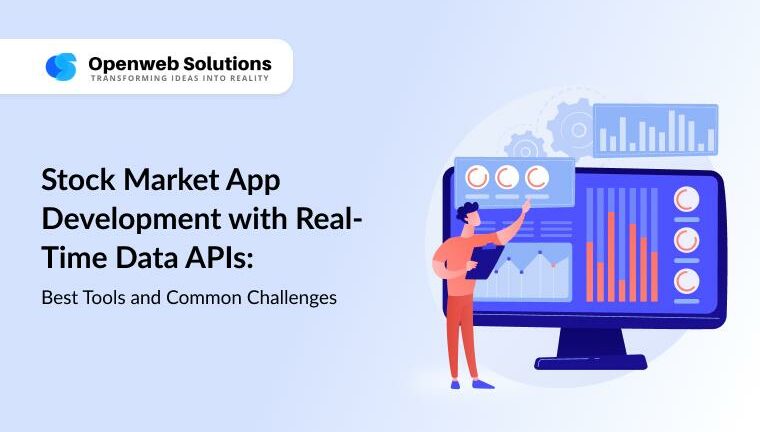
Today’s investors demand precision, speed, and seamless digital experiences. In India and across the globe, stock market app development has shifted from simply delivering trading features to building powerful, real-time ecosystems that empower users to act on market opportunities instantly. With the country’s retail investor base growing rapidly (crossing 154 million Demat accounts as of March 2024 per SEBI), real-time data APIs have become the backbone of modern trading applications. However, alongside incredible potential lie significant technical and regulatory hurdles.
Let’s explore the latest tools, trends, and challenges reshaping this space—and why choosing the right technology partner can define success in this competitive domain.
Why Real-Time Data is Central to Stock Market App Development
In volatile markets, even milliseconds matter. Real-time data transforms how investors trade, providing immediate insights into stock prices, order book movements, and news updates. Notably, with India’s shift to T+1 settlement, the urgency for instantaneous data processing has grown exponentially.
For developers engaged in stock market app development, integrating these fast-moving data streams is crucial to meet user expectations and regulatory standards.
Best Tools and APIs Driving Real-Time Stock Market App Development
Choosing robust tools and APIs is the first step toward building a reliable and scalable trading ecosystem. Below are some of the top solutions used globally and increasingly adopted in India’s fintech sector.
Alpha Vantage & IEX Cloud
These APIs remain favorites for startups and mid-sized platforms seeking affordable yet reliable data feeds. They provide:
-
Real-time equity quotes
-
Technical indicators
-
Forex and crypto market data
Moreover, their developer-friendly documentation makes integration smooth, which is essential for agile stock market app development cycles.
Using Polygon.io for Advanced Stock Market Software Development
Polygon.io has emerged as a preferred choice for stock market software development teams aiming for ultra-low latency data. Key benefits include:
-
Tick-by-tick price updates
-
Full-depth order books
-
Streaming options data
-
Cryptocurrency feeds
For Indian developers, while Polygon primarily focuses on US markets, its architecture offers a blueprint for handling similar low-latency data feeds from local exchanges.
Yahoo Finance API (via RapidAPI)
Despite being unofficial, Yahoo Finance APIs remain popular among developers for quick implementations. They’re handy for:
-
Historical price charts
-
Company fundamentals
-
News headlines
However, caution is warranted due to potential data licensing restrictions, especially in stock market software development projects catering to commercial users.
Firebase & PubNub
Real-time communication is vital for sending instant alerts, trade confirmations, or market updates. Tools like Firebase Realtime Database and PubNub excel at:
-
Delivering push notifications
-
Maintaining live chat functions
-
Ensuring low-latency updates
These technologies integrate seamlessly with cross-platform frameworks, enhancing mobile and web trading experiences.
React Native & Flutter
Cross-platform development has become essential in stock market app development to control costs while reaching wider audiences. React Native and Flutter are widely adopted for:
-
Building high-performance apps
-
Delivering consistent UI across Android and iOS
-
Faster deployment cycles
Leading Indian fintech apps like Groww and Zerodha have leveraged such frameworks to scale rapidly.
Key Challenges in Stock Market App Development
Even with excellent tools, building a successful trading platform demands tackling complex challenges. Let’s examine the most critical hurdles developers face today.
Latency and Data Accuracy
Speed is everything in trading. Apps must handle:
-
Massive real-time data streams
-
Sub-second response times
-
Seamless user experiences under peak load
As per industry benchmarks, delays of even 50 milliseconds can impact high-frequency trades. Thus, stock market app development requires advanced caching, edge computing, and optimized APIs.
Regulatory Compliance Across Markets
Indian developers must comply with SEBI guidelines, while those targeting global markets need to navigate:
-
FINRA (US)
-
FCA (UK)
-
ESMA (EU)
Data handling, user privacy, and transaction reporting all fall under strict scrutiny. Fines for non-compliance can be significant, making regulatory expertise crucial in stock market software development.
Scalability and Traffic Spikes
Trading apps often face traffic surges during market openings, earnings seasons, or significant news events. Scalability challenges include:
-
Load balancing
-
Horizontal scaling
-
Efficient database architecture
Platforms like AWS and Azure offer powerful solutions, but cost management becomes a significant factor for startups.
Security and Data Privacy
Handling sensitive financial data demands bulletproof security measures, including:
-
End-to-end encryption
-
Two-factor authentication
-
Secure API calls
-
Regular vulnerability scans
Recent breaches in global fintech apps have highlighted the reputational damage and legal risks associated with lax security.
UI/UX Complexity
Presenting vast financial data without overwhelming users is an art. Effective UI/UX design is vital to:
-
Simplify trading processes
-
Enable quick decision-making
-
Reduce user errors
Especially in India, where retail investors span diverse demographics, balancing simplicity and depth is essential for successful stock market website development and apps alike.
The Role of Stock Market Website Development in a Holistic Strategy
While mobile apps dominate trading activity, stock market website development remains a strategic asset for many firms. Websites enable:
-
Advanced data visualization (charts, heatmaps, analytics)
-
SEO-driven customer acquisition
-
Seamless integration with backend systems
By syncing app and website architectures, companies can provide consistent experiences across platforms while reducing development costs.
Notably, major players like Zerodha and Upstox maintain robust web portals alongside their apps, enhancing reach and user trust.
Global and Indian Trends Shaping the Future
The future of trading tech is evolving fast. Here’s what’s redefining stock market app development:
-
AI and Machine Learning – Platforms like Zerodha’s Kite are integrating predictive analytics to suggest trades.
-
Voice-activated trading – Growing in Western markets, expected to penetrate India as voice technology adoption rises.
-
Blockchain integrations – Offering secure, tamper-proof records for trades and settlements.
-
T+1 Settlement Push – In India, SEBI’s T+1 transition demands faster clearing systems, creating fresh opportunities for real-time solutions.
These trends aren’t just buzzwords—they’re shaping real product roadmaps for forward-looking developers and fintech firms.
Conclusion: Future-Proofing with Stock Market Software Development
The digital trading landscape in India and beyond is evolving faster than ever. Developers and businesses aiming to lead must embrace real-time data integration while balancing security, compliance, and user experience. Moreover, investing in robust stock market software development and stock market website development ensures long-term scalability and competitive advantage.
Ultimately, those who adapt quickly will not only meet the needs of modern investors but also position themselves as innovators in this booming sector.
FAQs
Q1. Which real-time data APIs are most reliable for stock market app development?
Ans: Alpha Vantage, IEX Cloud, Polygon.io, and Yahoo Finance via RapidAPI are trusted choices, depending on data depth and regional focus.
Q2. How can I keep my stock market app secure?
Ans: Use secure APIs, encrypt data, implement two-factor authentication, and schedule regular code and security audits.
Q3. What’s the biggest technical hurdle in developing a stock market app?
Ans: Minimizing latency while maintaining accuracy and regulatory compliance is the toughest challenge for developers.
Q4. Can a single backend support both an app and a trading website?
Ans: Absolutely. Many firms now build unified backend systems, ensuring data consistency and reducing operational costs.
Q5. Why is UX so crucial in trading apps?
Ans: A well-designed UX simplifies complex financial data, enabling users to make fast, informed decisions—a necessity in fast-moving markets.

Partha Ghosh is the Digital Marketing Strategist and Team Lead at PiTangent Analytics and Technology Solutions. He partners with product and sales to grow organic demand and brand trust. A 3X Salesforce certified Marketing Cloud Administrator and Pardot Specialist, Partha is an automation expert who turns strategy into simple repeatable programs. His focus areas include thought leadership, team management, branding, project management, and data-driven marketing. For strategic discussions on go-to-market, automation at scale, and organic growth, connect with Partha on LinkedIn.