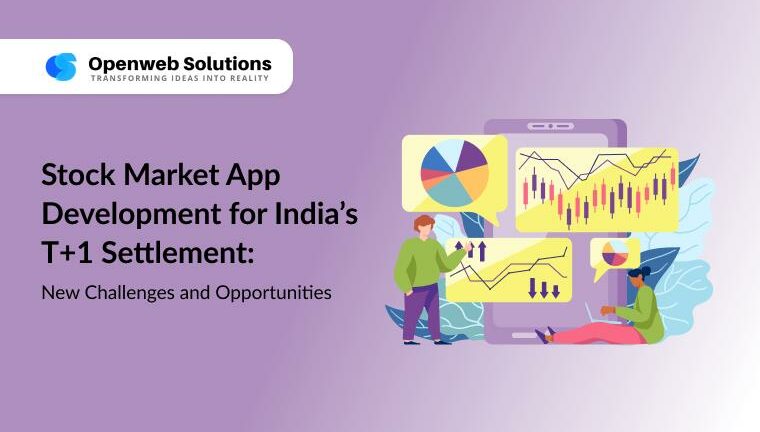
India’s capital markets are witnessing rapid transformation, especially with the shift to the T+1 settlement cycle. This significant regulatory change demands faster trade settlements and seamless digital infrastructure. As a result, stock market app development has emerged as a crucial domain that must evolve to meet rising expectations for speed, accuracy, and user engagement.
In this article, we explore the T+1 revolution, how it impacts technology platforms, and why businesses investing in stock market software development and stock market website development stand to gain massively from this shift.
Understanding T+1 Settlement and Its Impact on Stock Market Platforms
Historically, Indian stock trades followed a T+2 cycle, meaning settlements were completed two business days after trade execution. However, effective from January 2023, the Securities and Exchange Board of India (SEBI) fully implemented T+1 for all stocks. This move puts India ahead of most global markets in settlement speed, including the US, which is preparing for its own T+1 rollout by May 2024.
Under T+1:
-
Trades executed on Monday must settle on Tuesday.
-
Investors receive shares and funds a day earlier.
-
Liquidity improves across markets.
This shift is transforming how developers approach stock market app development, demanding ultra-fast digital solutions that can handle real-time transactions and regulatory compliance.
Key Challenges for Stock Market App Development in a T+1 Environment
While T+1 brings immense advantages, it also creates several technological challenges for developers and financial institutions.
Real-Time Data Processing and Low Latency
With trades settling in just one day, stock market software development must ensure platforms process massive data streams instantly. Apps now require:
-
Low-latency APIs for order matching and trade confirmations.
-
Edge computing to reduce delays in data transmission.
-
Cloud-based architecture that scales rapidly under load.
For instance, according to a 2024 report from the National Stock Exchange of India (NSE), daily average trading volumes surged by over 20% since T+1 implementation. This volume spike places enormous pressure on app servers to remain responsive during market hours.
Advanced Compliance, KYC, and AML Integration
Faster settlement also shortens compliance windows. Therefore, apps must integrate advanced:
-
e-KYC tools with AI-driven identity validation.
-
AML (Anti-Money Laundering) algorithms to flag suspicious activity.
-
Automated reporting to SEBI and exchanges.
SEBI’s recent circulars mandate robust digital KYC norms, pushing developers to embed compliance deeply into stock market app development workflows.
Accuracy and Predictive Risk Management
There’s virtually no time for error correction under T+1. Thus, modern apps must:
-
Provide real-time risk analytics.
-
Deploy Machine Learning models to detect anomalies.
-
Ensure data consistency across trading, settlement, and reporting systems.
Global fintech firms are increasingly integrating AI into trading platforms, and Indian players must keep pace to remain competitive.
Emerging Opportunities in Stock Market App and Website Development
Despite the challenges, T+1 is a monumental opportunity for developers, brokers, and fintech startups.
Surge in Retail Investor Participation
T+1 enables quicker fund returns, encouraging retail investors to trade more frequently. As of March 2024, India crossed 14 crore (140 million) active Demat accounts—a historic high. Mobile apps with:
-
Multi-language support,
-
User-friendly dashboards,
-
Personalized notifications,
are critical for capturing this booming segment. Startups investing in stock market app development are best positioned to serve this growing user base.
Demand for Next-Gen Stock Market Software Development
Financial institutions are urgently upgrading legacy systems to stay compliant with T+1. There’s rising demand for:
-
Real-time trading dashboards.
-
Smart trading bots.
-
Predictive market analytics tools.
Custom solutions in stock market software development help brokers:
-
Manage larger volumes seamlessly.
-
Deliver personalized user experiences.
-
Integrate seamlessly with exchanges.
Growth in Stock Market Website Development for Regional Audiences
While mobile apps dominate, stock market website development remains critical, especially for Tier-II and Tier-III markets. Regional investors often prefer:
-
Web portals in local languages.
-
Voice search capabilities.
-
Intuitive charting tools.
Localized websites help attract first-time investors outside India’s metro cities. According to BSE data, participation from smaller towns has grown 35% post T+1, reflecting significant untapped potential.
Innovations Shaping the Future of Stock Market App Development
Looking forward, several trends will define how developers approach stock trading solutions.
AI-Powered Trade Assistance
AI chatbots are increasingly being used to:
-
Execute trades via voice or text commands.
-
Provide real-time stock recommendations.
-
Answer user queries in regional languages.
Global players like Robinhood and India’s Zerodha are investing heavily in AI to enhance user experience—a trend likely to accelerate under T+1 demands.
Blockchain for Transparent Settlement
Though not yet mainstream in India, blockchain has potential to:
-
Record immutable trade logs.
-
Reduce settlement errors.
-
Enhance trust across stakeholders.
Innovators in stock market software development are exploring how decentralized ledgers might support faster, error-free T+1 processes in the future.
Cloud-Based Scalability
T+1 demands extreme system scalability. Consequently, brokers and exchanges are moving workloads to the cloud for:
-
Elastic server capacity.
-
Cost-effective scaling.
-
Faster disaster recovery.
Major exchanges like NSE are already adopting hybrid cloud models, inspiring developers to build apps that integrate seamlessly with these environments.
Conclusion: T+1 as a Catalyst for Future-Ready Platforms
India’s T+1 transition marks a significant milestone not just for the regulatory landscape but for the entire digital ecosystem powering the stock market. Developers focused on stock market app development are uniquely positioned to capitalize on this change, delivering tools that are faster, safer, and more user-centric.
Yet, it’s equally crucial for firms to invest in robust stock market software development and stock market website development. Together, these technologies ensure India’s capital markets remain competitive globally while opening new avenues for innovation and customer engagement.
Powerful FAQs
Q1. What is T+1 settlement in India’s stock market?
Ans: T+1 settlement means trades must be settled on the next business day, reducing the earlier T+2 timeframe. It speeds up fund availability and enhances liquidity.
Q2. How does T+1 affect stock market app development?
Ans: Apps need ultra-fast data processing, compliance checks, and real-time user notifications to support accelerated trade cycles.
Q3. Why is AI important in modern stock market software development?
Ans: AI improves predictive analytics, risk management, and personalized trading experiences, crucial under T+1’s tight timelines.
Q4. Can blockchain support T+1 settlement processes?
Ans: Yes. Blockchain could enhance settlement transparency and reduce errors, although large-scale adoption in India is still evolving.
Q5. Is regional language support important in stock market website development?
Ans: Absolutely. Regional content and localized UX help engage Tier-II and Tier-III investors, a key growth area in India’s trading landscape.

Partha Ghosh is the Digital Marketing Strategist and Team Lead at PiTangent Analytics and Technology Solutions. He partners with product and sales to grow organic demand and brand trust. A 3X Salesforce certified Marketing Cloud Administrator and Pardot Specialist, Partha is an automation expert who turns strategy into simple repeatable programs. His focus areas include thought leadership, team management, branding, project management, and data-driven marketing. For strategic discussions on go-to-market, automation at scale, and organic growth, connect with Partha on LinkedIn.