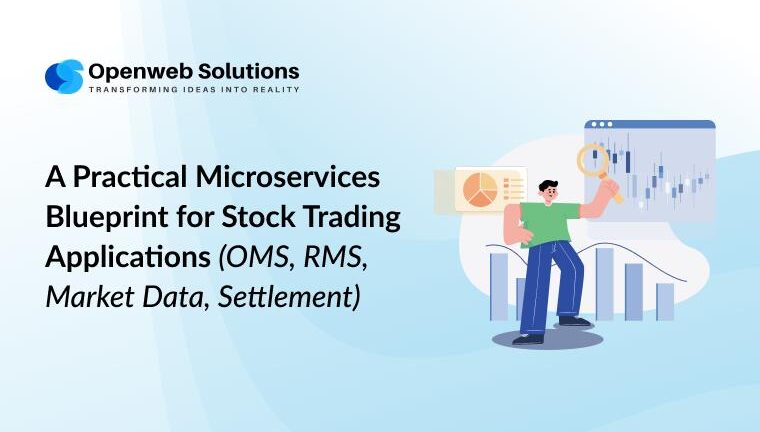
Modern stock trading is a battlefield of milliseconds as a single poorly designed system component can cascade into trade failures or massive financial loss. The old monolithic approach where every function lives in one giant codebase as trading volumes grow and regulatory demands tighten. Enter the microservices trading platform architecture that breaks down a trading application into small deployable services owning a specific business domain. This blueprint has become the gold standard for brokerages and trading platforms that need to scale fast without sacrificing reliability. In this blog, we walk through a practical microservices blueprint focused on four critical pillars and show how they come together using a trading platform.
Table of Contents
Why Microservices for Trading Platforms?
A trading platform is a collection of very different problems running simultaneously. Order routing needs ultra-low latency. Risk checks need real-time data pipelines. Settlement needs transactional accuracy and audit trails. Market data feeds need high-throughput streaming.
Trying to solve all these inside one monolith creates dangerous dependencies. A memory leak in the settlement module shouldn’t bring down order routing. A market data spike shouldn’t slow down risk calculations.
Each service scales independently with a trading app microservices architecture. OMS instances can be horizontally scaled during peak market hours. The market data service can be tuned for throughput while the settlement service is tuned for consistency. Development teams work in parallel without stepping on each other’s code.
The Four Core Services Explained
Order Management System
This is the beating heart of any trading platform as it receives trade orders from clients or algorithms and tracks their lifecycle from placement to execution. The OMS should expose a well-defined REST and publish order state changes to a message broker like Apache Kafka in a microservices design.
Key design rule
The OMS must never block external calls as all risk checks and market data lookups should be asynchronous.
Risk Management System
This is the safety layer before any order reaches the exchange as it passes through RMS checks with margin of sufficiency and regulatory thresholds. These checks must be completed in microseconds in a high-frequency environment. The two services communicate through an event stream rather than synchronous API calls in an OMS RMS microservices design. The OMS publishes an event and the RMS evaluates the order against the trader’s current positions either it is approved or rejected. It can be redeployed without touching the OMS if the RMS needs to update risk models or apply new regulatory rules.
Market Data Service
It ingests real-time price feeds from exchanges and normalizes them into a common internal format by distributing them to all consuming services. This service uses WebSocket or MQTT for downstream delivery and Kafka for internal fan-out. Caching layers sit in front of the most frequently accessed tick and historical data is stored in a time-series database like Influx DB.
Settlement Service
Settlement is where trades become money and coordinate with custodians by clearing houses and internal ledgers to ensure funds and securities are transferred correctly. This service prioritizes consistency over speed uses saga patterns or two-phase commits to ensure that partial settlements are never silently committed. Every action generates an immutable audit log with a legal and regulatory requirement. The Settlement service communicates with other services exclusively through events.
Event-Driven Architecture That Holds It Together
The secret ingredient in a trading platform event-driven architecture is the message broker. Apache Kafka is the dominant choice in production trading systems due to its durability and high throughput. Every significant action with order created and settlement initiated becomes a named event on a Kafka topic. Services subscribe to the topics they care about which means:
- Loose coupling: Services don’t know about each other but only about events.
- Replay ability: It can replay missed events without data loss if the settlement service goes down.
- Auditability: The Kafka log itself becomes a complete audit trail of every action on the platform.
A well-designed event schema with versioning prevents breaking changes from cascading across services.
Key Principles of OMS RMS Microservices
A few non-negotiable principles govern good trading microservices design:
- Each service owns its data as OMS and RMS has its own database.
- Idempotency is mandatory as duplicate events must not result in duplicate orders or charges.
- Circuit breakers everywhere if the RMS is slow or down.
- Observability is distributed tracing and metrics are not optional in a production trading system.
Common Pitfalls to Avoid
Even well-intentioned microservices architectures run into trouble when teams make these mistakes:
- Too many synchronous inter-service calls kill latency prefer async events.
- Sharing a database between OMS and RMS defeats the purpose of microservices and creates hidden coupling.
- An un versioned event schema change by one team can silently break another team’s consumer.
- Each service should be testable in isolation with mock event streams.
Build Your Trading Platform with Us
Talk to our stock market software specialists and get a free architecture consultation for your business.
Request a Free Consultation →
Conclusion
A well-designed microservices trading platform architecture is a business one as it enables faster feature delivery and the kind of regulatory compliance that modern financial markets demand.
By separating all of them into dedicated services and wiring them together with an event-driven backbone where teams can build trading platforms that are resilient under load and trustworthy to traders. We have been building specialized stock market software since 2010 with deep expertise in trading apps across modern cloud-native stacks.
FAQs
Q1. What is a microservices trading platform architecture?
It is a design approach where a trading application is broken into small deployable services handling a specific function like order management or settlement.
Q2. How do OMS RMS microservices improve risk management?
By decoupling the OMS and RMS as separate services communicating through events, risk checks can be updated or scaled independently without disrupting order flow.
Q3. Why is Kafka commonly used in trading platform event-driven architecture?
It offers high-throughput and durable as what trading systems need with the model allows any number of services to consume the same trade events independently.

Partha Ghosh is the Digital Marketing Strategist and Team Lead at PiTangent Analytics and Technology Solutions. He partners with product and sales to grow organic demand and brand trust. A 3X Salesforce certified Marketing Cloud Administrator and Pardot Specialist, Partha is an automation expert who turns strategy into simple repeatable programs. His focus areas include thought leadership, team management, branding, project management, and data-driven marketing. For strategic discussions on go-to-market, automation at scale, and organic growth, connect with Partha on LinkedIn.