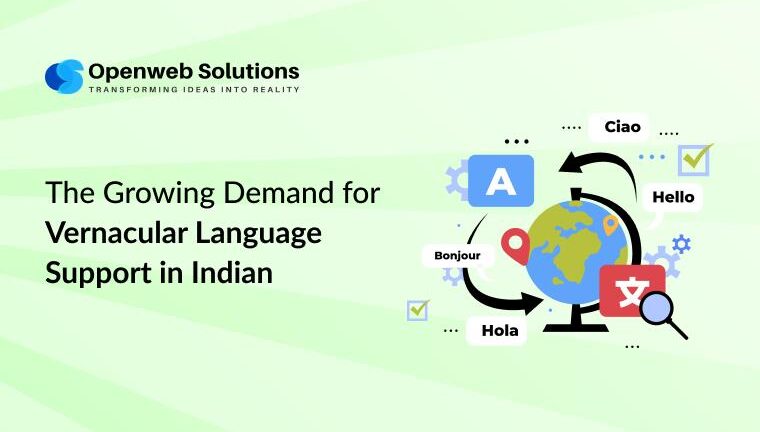
India is in the middle of a remarkable investing revolution. With over 130+ million registered investors on the NSE and the number of active Demat accounts crossing 160 million in 2024, the stock market is no longer the exclusive playground of English-speaking urban professionals. A new wave of first-time investors from Tier 2 and Tier 3 cities, speaking Hindi, Tamil, Telugu, Bengali, Marathi, Gujarati, and dozens of other languages. This blog explores why vernacular language support is fast and what it means for developers to build the next generation of stock trading apps.
Table of Contents
- India’s Linguistic Diversity: The Untapped Market
- Why Vernacular Language Support Matters in a Trading App
- The Tier 2 and Tier 3 City Investor Boom
- Challenges of Building Multilingual Stock Market
- Key Features a Multilingual Trading App Must Have
- The Business Case for Going Vernacular
- Conclusion
- FAQs
India’s Linguistic Diversity: The Untapped Market
India has 22 officially recognized languages and hundreds of dialects. According to the 2011 Census, only about 10% of Indians speak English as a first or second language with confidence. That means nearly 1.2 billion people are more comfortable consuming information and acting in a regional language. It is a genuine obstacle that prevents millions of capable, financially active Indians from participating in the equity markets confidently.
Why Vernacular Language Support Matters in a Trading App
It is a platform where a user makes decisions involving real money and here’s why vernacular support is important:
- Users who operate in their mother tongue understand interfaces and instructions far faster.
- Better financial literacy like P/E ratio or derivative contracts are difficult enough in English.
- Higher trust is likely to trust a share market app that communicates with them in a language they understand deeply.
- Lower support costs as many customer support queries stem from language confusion.
The Tier 2 and Tier 3 City Investor Boom
The post-pandemic period triggered an extraordinary surge in first-time retail investors across smaller Indian cities. Cities like Patna, Coimbatore, Surat, Nagpur, Indore, Bhubaneswar, and Lucknow saw Demat account opening skyrockets. Platforms that recognize this demographic shift and invest in vernacular support are already gaining a competitive edge. For companies offering stock market software development services, this represents a product opportunity.
Challenges of Building Multilingual Stock Market
Building a multilingual trading platform is more complex and the key challenges include:
- Many financial terms do not have direct regional equivalents and translating them requires domain expertise.
- Languages like Urdu require RTL rendering, which demands careful UI/UX architecture from the ground up.
- Streaming stock prices and alerts all need to be rendered accurately in Unicode-compliant regional scripts.
- Across Android devices with varying OS versions, rendering Tamil or Bengali fonts consistently can be challenging.
- News feeds and push notifications need localization pipelines, not just static translations.
Key Features a Multilingual Trading App Must Have
When developing or upgrading a stock market trading app India with vernacular support, the following features are essential:
- Allow users to pick their preferred language during signup and remember it across sessions.
- Alerts must fire in the user’s language as an English alert defeats the purpose for a Hindi-speaking user.
- Support documentation and chatbot responses should all be available in supported languages.
- With speech recognition for Indian languages improving rapidly, voice-based order placement is becoming viable.
- Market basics and stock analysis should be accessible in vernacular for new investors.
- Whether human or AI-powered, support in the user’s language is a major trust-builder.
The Business Case for Going Vernacular
India’s current active investor base of 80 million is a fraction of the estimated 300–400 million financially eligible adults who have not yet entered the market. A portion of this untapped audience is held back by language barriers. Platforms that solve this problem first will capture a disproportionately large share of the next wave of growth. For brokers and fintech startups working with a stock market software development partner, investing in vernacular localization is a market expansion strategy.
Build a Multilingual Stock Trading App with Us
We specialize in building powerful and fully customized stock market software. With 12+ years of experience in financial software development, our team is ready to bring your vision to life.
Conclusion
The Indian stock market’s next great growth story will be written in Hindi, Tamil, Telugu, Bengali, and dozens of other languages. As smartphone penetration deepens and financial awareness spreads into every corner of the country, the demand for vernacular language support in stock trading apps will only intensify.
Thank you for reading.
FAQs
Q1. Why is vernacular language support important in a stock trading app?
It supports ensures that non-English-speaking investors can understand market data and trading instructions accurately.
Q2. Which Indian languages should a stock market trading app in India support first?
Given user base and investor distribution, Hindi, Tamil, Telugu, Marathi, Bengali, Gujarati, and Kannada are the highest-priority languages.
Q3. How difficult is it to add multilingual support to an existing online trading app?
The complexity depends on how the app was originally designed as apps built with localization frameworks from the start can add new languages quickly.

Partha Ghosh is the Digital Marketing Strategist and Team Lead at PiTangent Analytics and Technology Solutions. He partners with product and sales to grow organic demand and brand trust. A 3X Salesforce certified Marketing Cloud Administrator and Pardot Specialist, Partha is an automation expert who turns strategy into simple repeatable programs. His focus areas include thought leadership, team management, branding, project management, and data-driven marketing. For strategic discussions on go-to-market, automation at scale, and organic growth, connect with Partha on LinkedIn.