The financial technology industry has transformed in the past decade. Businesses today rely on stock market software to manage trading operations and execute transactions in real time.
Whether it is a brokerage firm or fintech company, having reliable trading software is essential for success. Many software providers deliver solutions where the client only receives limited access to the system, while the developer retains control of the source code.
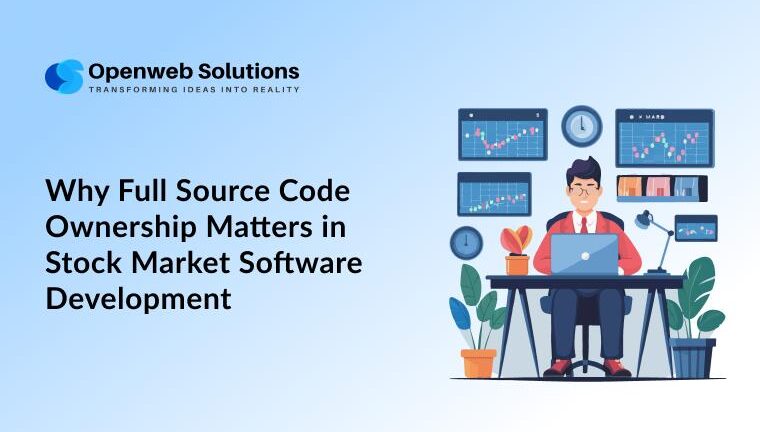
Full source code ownership ensures that the organization developing the platform has complete control over its trading platform software, enabling better security and long-term sustainability. In this blog, we will explore why owning the source code is crucial when developing software for stock trading.
Table of Contents
Definition of Source Code Ownership in Stock Market Software
Source code refers to the original programming instructions that developers write to build a software application.
In the case of a trading platform, this code controls every function such as market data integration, trade execution, user authentication, charting tools, risk management systems, and analytics.
When a company owns the source code of its stock market software, it means the organization has complete legal and technical control over the application.
This includes the ability to improve the system, fix bugs, add new trading features, integrate third-party tools, and transfer development to another team if needed.
Why Full Source Code Ownership Matters in Stock Market Software
Modern financial markets require continuous platform upgrades and technological flexibility.
Trading platforms must constantly evolve to support new financial instruments, regulatory updates, improved analytics, and faster trade execution.
Companies running a stock trading platform cannot afford delays or restrictions caused by limited software control. Full ownership of trading platform software ensures that businesses can quickly respond to market demands and technological advancements.
Key Benefits of Full Source Code Ownership in Stock Market Software
Complete Control Over the Platform
Owning the source code gives businesses full authority over their stock market trading software.
They can customize features and adapt the platform according to user needs without relying on the original developer. This level of control is particularly important for businesses that want to build unique software for stock trading for their customers.
Improved Security
Security is one of the most critical aspects of financial software.
Trading platforms handle sensitive information such as investor portfolios, transaction records, account details, and market positions.
When businesses own the code behind their stock trading platform, they can conduct independent security audits and implement advanced protections.
Long-Term Cost Efficiency
Full source code ownership reduces long-term operational dependency on vendors.
Some software vendors charge recurring fees for maintenance or API integrations. Ownership eliminates this dependency, allowing companies to manage their trading platform software internally or with different development partners.
Unlimited Customization
Every brokerage or fintech company has unique operational requirements.
Owning the source code allows businesses to customize their stock market software by adding features such as advanced charting tools, portfolio management systems, custom trading indicators, automated trading algorithms, and AI-driven investment insights.
Easier Scalability
Growing trading platforms require scalable technical infrastructure.
As a trading platform expands, it must handle more users, larger transaction volumes, additional financial instruments, and multi-exchange integrations.
Full ownership of the source code makes it easier to scale stock market trading software without architectural limitations.
Risks of Not Owning the Source Code in Stock Market Software
Many businesses initially adopt solutions where vendors retain control of the source code.
This approach may appear convenient initially but introduces several long-term risks:
- Businesses become dependent on a single vendor for updates and modifications.
- Adding new features to the stock trading platform may require negotiations or additional fees.
- Maintenance and upgrades often involve recurring payments.
- Companies cannot independently verify the security of their software for stock trading.
- If the vendor discontinues the product, the business may lose access to critical systems.
Importance for Stock Trading App Development and Market Platforms
Mobile trading has become increasingly popular as investors prefer managing portfolios through smartphones.
Modern stock trading app development focuses on creating seamless mobile experiences that allow users to track stock prices in real time, execute trades instantly, analyse charts and indicators, and monitor portfolios.
When companies fully own the source code behind their mobile stock market software, they can continuously enhance the application by introducing AI-based trading recommendations, advanced analytics tools, multi-device synchronization, and faster order execution systems.
Build a Stock Market Software Solution with Us
Work with experienced developers who provide fully customizable trading systems with complete source code ownership.
Build a secure trading platform that grows with your business and adapts to the evolving financial market. Contact our team today!
Conclusion
Building a successful trading system requires more than just powerful features and attractive user interfaces.
The foundation of any reliable stock market software lies in ownership and control of its source code.
Full source code ownership empowers businesses to customize their stock market trading software, strengthen security, reduce long-term costs, and scale their trading platforms without restrictions.
For companies planning to develop a stock trading platform, ensuring complete access to the underlying code is essential for long-term success.
Thank you for reading.
FAQs
Q1. What is stock market software?
Ans: It is a digital platform that allows users to analyse financial markets and execute buy or sell trades through a trading system.
Q2. Why is source code ownership important in trading platforms?
Ans: It ensures businesses have complete control over their stock market trading software, enabling customization, security improvements, and long-term scalability.
Q3. What features should a stock trading platform include?
Ans: A modern platform should include real-time market data, advanced charting tools, analytics dashboards, portfolio tracking, and secure trade execution.

Partha Ghosh is the Digital Marketing Strategist and Team Lead at PiTangent Analytics and Technology Solutions. He partners with product and sales to grow organic demand and brand trust. A 3X Salesforce certified Marketing Cloud Administrator and Pardot Specialist, Partha is an automation expert who turns strategy into simple repeatable programs. His focus areas include thought leadership, team management, branding, project management, and data-driven marketing. For strategic discussions on go-to-market, automation at scale, and organic growth, connect with Partha on LinkedIn.