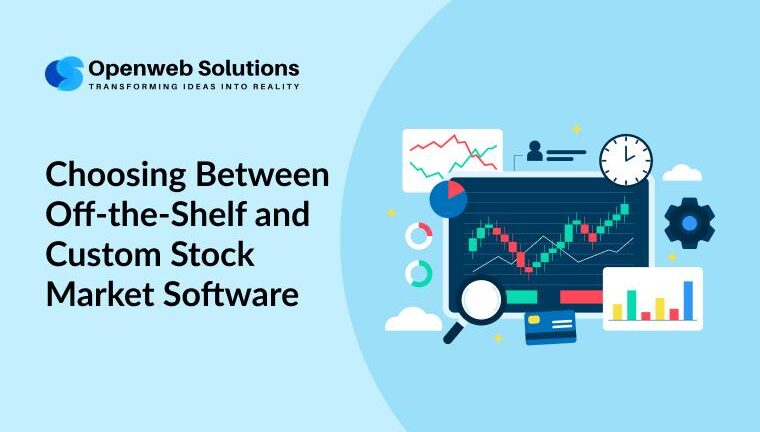
The demand for advanced trading software and digital investing tools has grown rapidly as more traders and financial institutions move online. Whether you are a brokerage firm or trading service provider, selecting the right stock trading platform is one of the most critical decisions for your business. Both options have their own advantages and cost implications. Making the wrong choice can lead to scalability issues or operational inefficiencies later. This blog will help you understand the differences and choose the right software for stock trading based on your business goals.
Table of Contents
- Definition of Off-the-Shelf Trading Software
- Meaning of Custom Stock Market Software
- Advantages of Off-the-Shelf Trading Software
- Limitations of Ready-Made Solutions
- Benefits of Custom Trading Platform Software
- Challenges of Custom Development
- Key Factors to Consider Before Choosing
- Choosing the Best Option for Your Business
- Conclusion
Definition of Off-the-Shelf Trading Software
The platform is a pre-built solution available for immediate purchase or subscription. These platforms are developed for a wide range of users and come with standard trading features. Common examples include platforms offering market data integration, basic charting tools, order execution, portfolio tracking, and broker integrations. These systems are ready to deploy with minimal customization.
Meaning of Custom Stock Market Software
It is built specifically for your business requirements. Development teams design the platform according to your target user base, business model, branding, feature requirements, compliance needs, and scalability goals. Custom software allows companies to build a fully branded and differentiated stock trading platform.
Advantages of Off-the-Shelf Trading Software
Faster Deployment
Ready-made platforms allow companies to launch quickly without long development cycles.
Lower Initial Investment
Subscription or licensing fees are often cheaper upfront compared to building custom software.
Proven Functionality
Many platforms are already tested and used widely, reducing early technical risks.
Basic Support & Maintenance
Providers typically handle updates and system maintenance.
Limitations of Ready-Made Solutions
However, off-the-shelf solutions come with restrictions. You cannot fully tailor the platform to your business strategy or user needs. Your platform may look like competitors using the same software. As your user base grows, performance and flexibility may become limitations. You depend on the vendor’s roadmap for new features and upgrades. Subscription and licensing fees can become expensive over time.
Benefits of Custom Trading Platform Software
Custom development offers strategic advantages like you can design user flows to beginner traders or institutional clients. Custom software enables features like AI-powered analytics, advanced charting tools, custom alerts, multi-market integration, algorithmic trading modules, risk management dashboards, and performance. Your system can be built to support millions of users. You own the platform and unique features differentiate your business in a crowded trading market.
Challenges of Custom Development
Despite benefits, custom development also presents challenges. Development investment is higher compared to ready-made software. Building trading software takes planning and iterations. You need a technical team for updates and improvements. However, these challenges are usually outweighed by long-term strategic benefits.
Key Factors to Consider Before Choosing
- Launching a basic trading service or building a large fintech platform
- Retail traders, professional traders, or institutional clients have different needs
- Consider both short-term and long-term costs
- Advanced analytics, automation, and integrations may require customization
- Financial software requires strong data protection and regulatory compliance
Choosing the Best Option for Your Business
Choose off-the-shelf software if you need quick market entry, budget is limited, you only need basic trading functionality, and you are testing a new idea or market. Choose custom software if you want to build a unique trading ecosystem, you expect rapid user growth, you need advanced features, branding and differentiation are priorities, and long-term scalability matters. Most growing fintech companies eventually shift toward custom development.
Launch Your Trading Platform with Us
Partner with expert developers to build secure and feature-rich stock market trading software for your business needs. Contact our team today to discuss your custom trading platform development requirements!
Conclusion
The decision between off-the-shelf and custom stock market trading software depends on your business vision. Ready-made trading software offers quick deployment and lower initial costs but limits flexibility and scalability. On the other hand, custom trading platform software requires higher investment but provides long-term competitive advantages and scalability. If your goal is to build a future-ready stock trading platform, custom development often becomes the smarter long-term choice.
Thank you for reading.
Frequently Asked Questions
Q1. Is custom trading software expensive?
Ans: Initial development costs are higher, but long-term benefits and ownership often make it cost-effective.
Q2. Is custom software more secure?
Ans: Yes, custom systems can implement tailored security protocols and compliance measures.
Q3. Which option is better for fintech startups?
Ans: Startups testing ideas may start with ready-made solutions but often move to custom platforms as they scale.

Partha Ghosh is the Digital Marketing Strategist and Team Lead at PiTangent Analytics and Technology Solutions. He partners with product and sales to grow organic demand and brand trust. A 3X Salesforce certified Marketing Cloud Administrator and Pardot Specialist, Partha is an automation expert who turns strategy into simple repeatable programs. His focus areas include thought leadership, team management, branding, project management, and data-driven marketing. For strategic discussions on go-to-market, automation at scale, and organic growth, connect with Partha on LinkedIn.