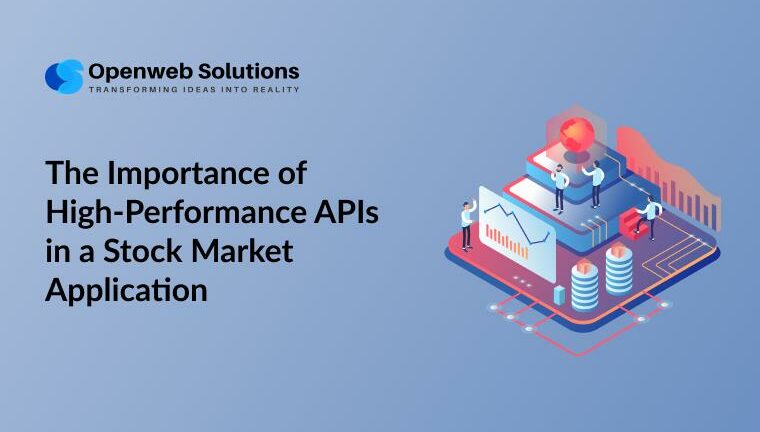
In today’s financial ecosystem, speed and accuracy define success. Stock traders, brokers, and financial institutions rely on real time stock market data to make decisions within seconds. Behind every smooth trade execution, live price update, and market alert lies a powerful component. Application Programming Interfaces are the backbone of modern stock market software and online trading platforms. They connect trading applications with stock exchanges, data providers, payment systems, and analytical tools. Without high-performance APIs, even the most advanced trading platform software would fail to deliver real-time insights and smooth user experiences. This blog explores why these are important to build secure application for trading.
APIs in a Stock Market Application
They act as communication bridges between different systems. In a stock market application, APIs enable real time stock data, order placement and execution, user authentication and account management, integration with third party financial tools, and data synchronization across devices.
For example, when a user checks stock prices or places a trade on an online trading platform, APIs fetch stock data from exchanges, validate the request, execute the trade, and return confirmation.
Why APIs Matter in the Real Time Stock Market
It operates at extreme speed where prices change every second. Even minor delays can lead to missed opportunities or financial losses. High performance APIs are essential because they minimize latency in data transmission, ensure instant trade execution, handle high volumes of concurrent requests, and maintain consistency across market updates.
A delay of even a few milliseconds in stock data delivery can impact trading decisions, especially for intraday traders and institutional investors.
Function of APIs in Trading Platform Software
Modern trading platform software depends on APIs for its core functionality. High performance APIs support:
- APIs deliver live price updates, market depth, indices, and volume data directly to user dashboards.
- They handle buy and sell orders, order modifications, cancellations, and confirmations with precision and speed.
- APIs enable trading platforms to connect with multiple exchanges from a single interface.
- Fast APIs ensure smooth navigation, real time charts, instant alerts, and responsive interfaces across web and mobile platforms.
Trading platforms would struggle with lag and inconsistent data delivery without efficient APIs.
APIs and Real Time Stock Data Processing
Handling stock data is one of the most complex tasks in stock market software. High performance APIs make it possible to stream real time stock prices, process large datasets instantly, update charts and indicators dynamically, deliver accurate historical, and live reports.
These APIs often use various technologies, event driven architectures, and caching mechanisms to maintain uninterrupted data flow. This ensures traders receive accurate market insights exactly when they need them.
Scalability and Reliability Through APIs in a Stock Market Application
As user bases grow, trading applications must handle thousands of requests simultaneously. High performance APIs ensure smooth scalability during peak trading hours, minimal downtime, load balancing across servers, and faster response times even under heavy traffic.
Market volatility, major economic events, or IPO launches can create sudden spikes in traffic. APIs built for performance and scalability help platforms stay reliable under pressure.
Security and Compliance in Stock Market Software
Security is a critical concern in stock market applications. APIs play a major role in protecting sensitive financial and user data.
High performance APIs are designed with secure authentication protocols, encrypted data transmission, rate limiting and monitoring, compliance with financial regulations, and standards. A secure API infrastructure helps prevent unauthorized access, data breaches, and fraudulent activities.
Choosing the Right Architecture for a Stock Market Application
Selecting the right API architecture is essential for long term success. Some best practices include using REST for flexibility, implementing real time streaming APIs for stock data and ensuring proper documentation.
An API ecosystem allows stock market software to adapt to changing business needs, integrate new features, and support future technologies like AI driven analytics.
Conclusion
High performance APIs are the foundation of every successful stock market application. They power real time data delivery, fast trade execution, system scalability, and secure operations.
As trading platforms evolve and user expectations rise, APIs must be designed to handle massive data loads with speed, reliability, and precision. Whether you are building custom stock market software, enhancing trading platform software, or launching a next generation online trading platform, investing in high performance APIs is a strategic one.
Frequently Asked Questions
Q1. Why are APIs important in stock market applications?
Ans: They enable real time stock data access and integration with exchanges and third party services, making them essential for smooth trading operations.
Q2. How do high performance APIs improve trading speed?
Ans: They reduce latency, process requests faster, and deliver real time updates instantly, which is critical in the real time stock market.
Q3. Can stock market software work without real time APIs?
Ans: Basic functionality is possible, but without real time APIs, trading platforms cannot provide live prices, instant execution, or competitive user experiences.

Partha Ghosh is the Digital Marketing Strategist and Team Lead at PiTangent Analytics and Technology Solutions. He partners with product and sales to grow organic demand and brand trust. A 3X Salesforce certified Marketing Cloud Administrator and Pardot Specialist, Partha is an automation expert who turns strategy into simple repeatable programs. His focus areas include thought leadership, team management, branding, project management, and data-driven marketing. For strategic discussions on go-to-market, automation at scale, and organic growth, connect with Partha on LinkedIn.