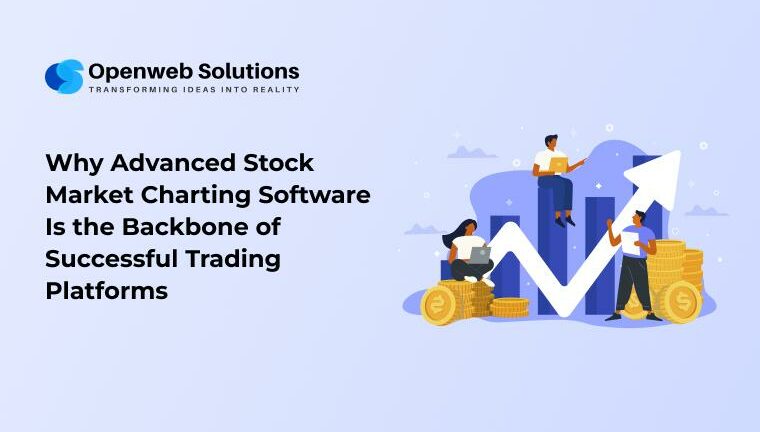
Traders rely on data insights to make decisions, and the process lies stock market charting software to transform raw market data into visual intelligence. Whether a platform serves retail traders or brokerage firms, advanced charting capabilities define its success. Without intuitive charts and real-time updates, even the most feature-rich trading platform can fail to meet user expectations. This is why this is widely considered the backbone of successful trading platforms.
Table of Contents
- Definition of Stock Market Charting Software
- Why Charting Is Central to Modern Trading Platforms
- Key Features of Advanced Stock Market Charting Software
- Role of Charting in Technical Analysis
- Enhancing Charting Software Through User Engagement
- Choosing the Right Charting Tools for Trading Platforms
- Conclusion
Definition of Stock Market Charting Software
Stock market charting software is a specialized system that visualizes historical and real-time market data through interactive charts. It enables traders to analyse price movements, volume, trends, and patterns across multiple timeframes.
Modern charting systems are far more than static graphs. They function as full-fledged stock market analysis tools, allowing users to apply indicators, compare multiple instruments, detect trends, and perform in-depth technical analysis. This software forms the foundation of stock analysis software and advanced investment platforms.
Why Stock Market Charting Software Is Central to Modern Trading Platforms
Advanced stock market charting software directly impacts how traders interpret and respond to market behaviour.
- Charts convert complex numerical data into easy-to-understand visuals, helping traders identify opportunities faster.
- Live price updates and dynamic charting allow traders to react instantly to market movements.
- Professional-grade charts signal platform reliability and attract serious traders who expect stock market technical analysis software.
- Without advanced charting, trading platforms struggle to deliver speed and confidence.
Key Features of Advanced Stock Market Charting Software
Successful platforms integrate powerful charting features that serve beginners and professional traders alike.
Multiple Chart Types
Line, candlestick, bar, and Renko charts allow users to analyse data from different perspectives.
Technical Indicators
Indicators such as RSI, MACD, Bollinger Bands, Moving Averages, and Fibonacci tools are essential components of technical analysis software.
Multi-Timeframe Analysis
Users can switch between intraday, daily, weekly, and monthly views to align short-term trades with long-term trends.
Customization & User Control
Advanced stock analysis software enables traders to customize indicators, layouts, colours, and chart templates.
Cross-Market Compatibility
Top-tier charting systems support equities, indices, commodities, currencies, and derivatives from multiple exchanges.
Role of Stock Market Charting Software in Technical Analysis
Technical analysis is built on the belief that price patterns and trends repeat over time. This makes stock market technical analysis software indispensable for traders.
Advanced charting software helps traders identify support and resistance levels, recognize chart patterns, analyse momentum, and back test strategies using historical data. By integrating powerful trading analysis software, platforms empower users to develop strategies based on data rather than emotions.
Enhancing Charting Software Through User Engagement
A platform’s long-term success depends on how effectively it engages traders.
- Interactive charts reduce cognitive load and make complex analysis more accessible.
- Traders spend more time on platforms that offer detailed, responsive charting tools.
- When built-in stock market analysis tools are comprehensive, users don’t need external charting platforms.
- Reliable charting builds confidence, leading to repeat usage and long-term retention.
Choosing the Right Stock Market Charting Software for Trading Platforms
Selecting the right stock market charting software is a strategic decision. Key considerations include performance and real-time data handling, scalability for growing user bases, custom indicator support, cross-platform compatibility, security, and data integrity.
A well-architected charting system ensures that trading platforms remain competitive in a crowded fintech landscape.
Partner with experienced developers who understand real-time data, technical analysis, and scalable trading systems. Get in touch today to create a powerful trading platform that traders trust!
Conclusion
Advanced charting software is the foundation upon which successful trading platforms are built. From enabling accurate technical analysis to improving user engagement and trust, charting tools play a critical role in how traders perceive and use a platform.
As markets grow more complex and data-driven, platforms that invest in technical analysis software and trading analysis software will stand out. Platforms with weak or outdated charting risk losing users to more sophisticated alternatives.
Thank you for reading.
Frequently Asked Questions
Q1) Why is stock market charting software important for traders?
Ans: It helps traders visualize price trends, analyse patterns, and make informed decisions using real-time and historical data.
Q2) Is charting software only for professional traders?
Ans: No, modern charting tools are designed for beginners and experienced traders, with customizable complexity levels.
Q3) What is the difference between stock analysis and charting software?
Ans: Charting software focuses on visual data representation, while stock analysis software may include screeners, reports, alerts, and portfolio tools.
Q4) Can charting software support multiple markets?
Ans: Yes, advanced stock market technical analysis software supports equities, commodities, currencies, and derivatives across multiple exchanges.
Q5) How does charting software impact platform performance?
Ans: Efficient charting improves user engagement and trust but must be optimized to handle real-time data without latency.

Partha Ghosh is the Digital Marketing Strategist and Team Lead at PiTangent Analytics and Technology Solutions. He partners with product and sales to grow organic demand and brand trust. A 3X Salesforce certified Marketing Cloud Administrator and Pardot Specialist, Partha is an automation expert who turns strategy into simple repeatable programs. His focus areas include thought leadership, team management, branding, project management, and data-driven marketing. For strategic discussions on go-to-market, automation at scale, and organic growth, connect with Partha on LinkedIn.