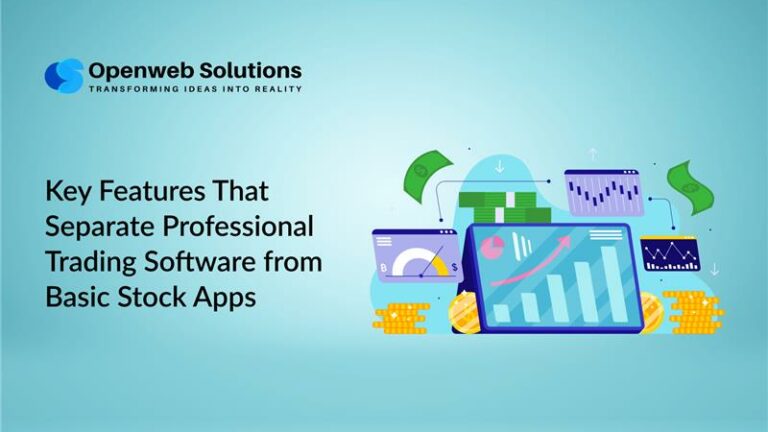
The growth of retail investing has led to various stock trading applications in the market. While basic stock apps are suitable for beginners who want to buy and sell a few shares, they fall short when it comes to meeting the need of serious traders and financial institutions. This is where stock market trading software makes a difference. A trading platform is about speed, accuracy, analytics, and control. Advanced trading software empowers users with real-time insights and infrastructure that basic apps simply cannot match.
In this blog, we’ll explore the key features that separate professional platforms from entry-level stock apps.
Table of Contents
- Real-Time Market Data & Low-Latency Execution
- Advanced Charting & Technical Analysis Tools
- Multi-Exchange & Multi-Asset Support
- Custom Watchlists & Filters
- Risk Management & Trade Control Features
- Performance & Reliability
- Security & Compliance Readiness
- Customization & Integration Capabilities
- Analytics & Decision Support
- Conclusion
- Frequently Asked Questions
Real-Time Market Data & Low-Latency Execution in Stock Market Trading Software
One of the most important features of a real time stock trading platform is instant access to live market data. Professional platforms deliver streaming quotes and order book data with minimal latency.
Basic stock apps often rely on delayed data or limited refresh intervals, which can lead to poor execution prices. In contrast, professional trading software is built with optimized data pipelines that ensure traders act on accurate information.
Advanced Charting & Technical Analysis Tools in Stock Market Trading Software
A core differentiator of professional systems is powerful technical analysis software. These platforms provide multiple chart types, dozens of built-in indicators, drawing tools for trendlines, and patterns with multi-chart analysis.
Basic apps may offer simple price charts, but they lack the depth required for strategic decisions. Serious traders rely on these tools to identify trends and entry or exit points with confidence.
Multi-Exchange & Multi-Asset Support in Professional Trading Platforms
Professional trading software is designed to handle multiple exchanges and asset classes from a single interface. Whether it’s equities, derivatives, commodities, currencies, or mutual funds, users can monitor and trade across markets.
Basic stock apps typically focus on a single exchange or limited asset categories, restricting diversification and advanced trading strategies.
Custom Watchlists & Filters in Stock Market Trading Software
Customization is a hallmark of a professional trading platform. Advanced systems allow users to create customized watchlists, stock screeners based on fundamental criteria, and filters for volume and volatility.
This flexibility enables traders to quickly identify opportunities aligned with their strategy, while basic apps usually offer predefined lists with limited filtering options.
Risk Management & Trade Control Features in Stock Market Trading Software
Professional trading software prioritizes risk control. Features such as trailing stop orders, position sizing tools, exposure monitoring, and risk-to-reward calculators help traders protect capital and manage volatility.
Basic stock apps often lack risk management tools, exposing users to unnecessary losses during fast market movements.
Performance & Reliability in Real Time Stock Trading Platforms
A real time stock trading platform must remain stable during peak market hours. Professional platforms are built on scalable architectures capable of handling thousands of concurrent users and high-frequency data flows.
Basic apps may experience slowdowns or outages during periods of high volatility, which can be costly for professional traders and brokers.
Security & Compliance Readiness in Stock Market Analysis Software
Security is non-negotiable in stock market analysis software. Professional platforms incorporate end-to-end encryption, secure authentication with role-based access, audit logs with transaction tracking, and compliance readiness for financial regulations.
Basic apps may implement only basic security measures and are rarely designed to meet enterprise or regulatory-grade standards.
Customization & Integration Capabilities in Professional Trading Software
Professional trading software is often built to integrate with third-party systems such as market data providers, payment gateways, back-office systems, and APIs for automated trading.
This flexibility allows brokers and fintech companies to adapt the platform to their business model, while basic stock apps offer little to no integration capability.
Analytics & Decision Support in Stock Market Trading Software
A stock market analysis software solution includes detailed reporting features such as:
- Trade history and performance reports
- Profit and loss analysis
- Portfolio allocation insights
- Tax and compliance reports
These insights help traders and institutions refine strategies and improve long-term performance.
Upgrade a Professional Trading Platform for Your Business
Get in touch with our experts today to develop secure and feature-rich stock market analysis software designed for real-time performance and long-term growth. Contact now for a free demo!
Conclusion
While basic stock apps serve as an entry point for casual investors, they lack the depth, speed, and reliability required for professional trading.
A professional trading platform is defined by real-time data, advanced analytics, risk controls, and customization. For traders and fintech businesses aiming to operate at a higher level, investing in professional trading software for stocks is essential.
The right platform empowers smarter decisions and supports sustainable growth in competitive financial markets.
Frequently Asked Questions
Q1. What is the main difference between professional trading software and basic stock apps?
Ans: Professional trading software offers real-time data, advanced analytics, and scalability, while basic apps focus on simple buy and sell functionality.
Q2. Who should use professional trading platforms?
Ans: Active traders, brokers, financial institutions, and fintech startups that require advanced features and high performance.
Q3. Is professional trading software suitable for beginners?
Ans: Yes, many platforms offer customizable interfaces that beginners can grow into as their trading experience increases.
Q4. Can professional platforms support multiple exchanges?
Ans: Yes, multi-exchange and multi-asset support is a core feature of professional trading systems.
Q5. Why is real-time data so important in trading software?
Ans: It ensures accurate pricing and timely execution, especially during volatile market conditions.

Partha Ghosh is the Digital Marketing Strategist and Team Lead at PiTangent Analytics and Technology Solutions. He partners with product and sales to grow organic demand and brand trust. A 3X Salesforce certified Marketing Cloud Administrator and Pardot Specialist, Partha is an automation expert who turns strategy into simple repeatable programs. His focus areas include thought leadership, team management, branding, project management, and data-driven marketing. For strategic discussions on go-to-market, automation at scale, and organic growth, connect with Partha on LinkedIn.