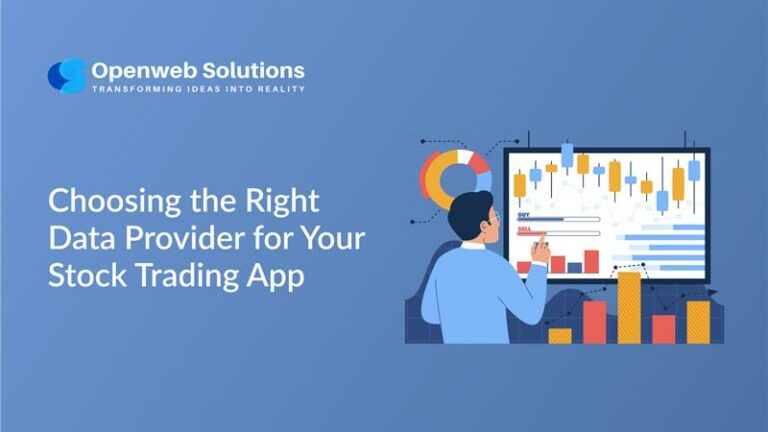
Choosing the Right Data Provider for Your Stock Trading App is the engine behind every great user experience. From live quotes and charts to alerts, technical indicators, and trading signals, your app lives or dies by its market data. A fast and reliable feed improves user trust and keeps advanced traders engaged. This guide walks you through what to ask for, how to evaluate vendors, and how to integrate their feeds so your app stays fast and dependable.
Introduction to Choosing the Right Data Provider for Your Stock Trading App
In digital trading, data is the engine that powers every user action. From live quotes and charts to alerts, technical indicators, and trading signals, your app lives or dies by its market data. A fast and reliable feed improves user trust and keeps advanced traders engaged. This guide walks you through what to ask for, how to evaluate vendors, and how to integrate their feeds so your app stays fast and dependable.
Why Choosing the Right Data Provider for Your Stock Trading App Matters
Every feature inside a stock trading app depends on market data. Even a small delay or an incorrect tick can trigger user complaints and damage your brand. A strong provider supplies the essentials your team needs to build with confidence:
- Real time and historical stock prices
- Level I quotes and Level II order book depth
- OHLC data for charting
- Corporate actions and market news
- Indices and derivatives coverage
- Global exchange support
Without dependable data, even a beautifully designed app falls short of trader expectations.
Key Types of Market Data You Need for Choosing the Right Data Provider for Your Stock Trading App
Real time market data
Essential for active traders who need updates in milliseconds. It drives quotes, time and sales, and live charts.
Historical data
Used for back testing, analytics, and long horizon charts. Ask for depth of history, survivorship bias handling, and corporate action adjustments.
Level II order book data
Shows bid and ask depth by price level or by participant where available. Vital for professional tools and advanced strategies.
Corporate actions and fundamentals
Dividends, splits, earnings, and symbol changes are key for research and accurate back adjusted charts.
Multi asset coverage
If you plan to support commodities, forex, crypto, futures, or ETFs, verify asset class coverage, symbology, and trading session rules.
Factors to Consider When Choosing the Right Data Provider for Your Stock Trading App
Data accuracy and reliability
Accuracy is non negotiable. Look for direct exchange feeds, redundant sourcing, strict data validation, and clear uptime commitments. Users will hold your app responsible for errors.
Latency and speed
Speed matters for traders. Prefer providers with ultra low latency networks, proximity or co location near exchanges, and efficient WebSocket streaming. Measure tick to screen delay in your own environment.
Exchange and asset coverage
Some vendors specialize in specific regions like NSE and BSE while others focus on US, EU, or multi region coverage. Map your roadmap to supported venues and asset classes.
API quality and documentation
A well designed API saves months. Prioritize clean REST endpoints for snapshots and historical pulls, WebSockets for streams, SDKs for major languages, comprehensive docs, clear rate limits, and example code. Stable versioning and thoughtful pagination are signs of maturity.
Security and compliance
Trading apps must respect exchange entitlements and financial data licensing. Look for SSL or TLS everywhere, secure token based auth, role based access, audit logs, and alignment with local rules such as SEBI, and with obligations from exchanges. Check for ISO style certifications where relevant.
Pricing and scalability
Market data is a significant cost. Model monthly licensing, per user exchange fees, redistribution terms, and differences between real time and delayed data. Start with a plan you can afford, but confirm the provider can scale as your user base grows without sudden price shocks.
Common Challenges in Choosing the Right Data Provider for Your Stock Trading App
- Frequent downtime or maintenance windows that overlap with market hours
- Slow refresh rate that ruins day trader experience
- Inconsistent or inaccurate symbols and prices across endpoints
- Limited exchange or asset coverage that blocks roadmap features
- Hidden fees for redistribution, entitlements, or depth levels
- Poor support or unclear SLAs
These issues directly affect user experience and brand credibility. Surface them early in vendor evaluations.
Best Practices for Integrating Market Data When Choosing the Right Data Provider for Your Stock Trading App
Architect for scale
Use caching layers for reference and static data, load balancers for your market data gateways, and optimized time series storage. Separate write heavy tick stores from analytics stores.
Split pipelines
Keep real time and historical pipelines separate. Stream quotes over WebSockets and fetch historical aggregates over REST. This reduces load and improves responsiveness.
Use streaming for live views
Adopt WebSockets for quotes, order books, and live charts. Fall back to polling only for non critical widgets.
Test for real spikes
Simulate market open, large earnings days, and budget announcements. Replay historical bursts to benchmark throughput, packet loss, and end to end latency.
Normalize your data
Vendors format symbols, sessions, and corporate actions differently. Create a normalization layer that unifies symbology, trading calendars, and time zones before your data hits widgets and charts.
Plan for redundancy
For mission critical apps, add a backup provider and a fast switchover plan. Keep a minimal hot path for quotes and charts even if non critical services are down.
Monitor everything
Track feed health, message rates, dropped updates, and user facing latency. Alert on stale symbols and empty order books.
Document entitlements
Automate user level permissions for real time data, depth levels, and venue access. Respect exchange rules and regional restrictions.
Bring Your Stock Market Software Idea to Life Now
Ready to build a stock analysis or trading application with rock solid data integration
We design and deliver trading software, portfolio tools, and custom financial platforms that feel fast and reliable from day one. Talk to our team for a free consultation and a clear plan to market.
Conclusion on Choosing the Right Data Provider for Your Stock Trading App
Choosing the right data partner is one of the most important decisions in your development journey. The right provider boosts user trust, delivers reliable feeds, and helps your app meet global quality standards. Invest in a provider that balances accuracy, speed, coverage, security, and cost. Your users will feel the difference every time they open the app.
Frequently Asked Questions
Q1. Why is a market data provider essential for a trading app?
Ans: Because every core feature from live quotes and charts to alerts and indicators depends on fast and reliable data.
Q2. Can I use free stock market data providers?
Ans: You can for learning or prototypes. For professional apps, free data is often delayed or incomplete. Paid data is recommended for accuracy, uptime, and compliance.
Q3. What kind of data does a trading app need?
Ans: Real time quotes, historical prices, corporate actions, order book depth for advanced users, and relevant news. If you support multiple assets, include futures, forex, crypto, or ETFs as needed.
Q4. How do I check a provider’s latency claims?
Ans: Measure end to end in your stack. Subscribe to a volatile symbol over WebSockets, time stamp events on arrival, and compare to exchange print times where allowed. Test during market open and high volume events.
Q5. Do I need more than one provider?
Ans: If your app is mission critical or you serve professional traders, yes. A secondary provider and a tested failover flow protect you from outages and vendor incidents.

Partha Ghosh is the Digital Marketing Strategist and Team Lead at PiTangent Analytics and Technology Solutions. He partners with product and sales to grow organic demand and brand trust. A 3X Salesforce certified Marketing Cloud Administrator and Pardot Specialist, Partha is an automation expert who turns strategy into simple repeatable programs. His focus areas include thought leadership, team management, branding, project management, and data-driven marketing. For strategic discussions on go-to-market, automation at scale, and organic growth, connect with Partha on LinkedIn.