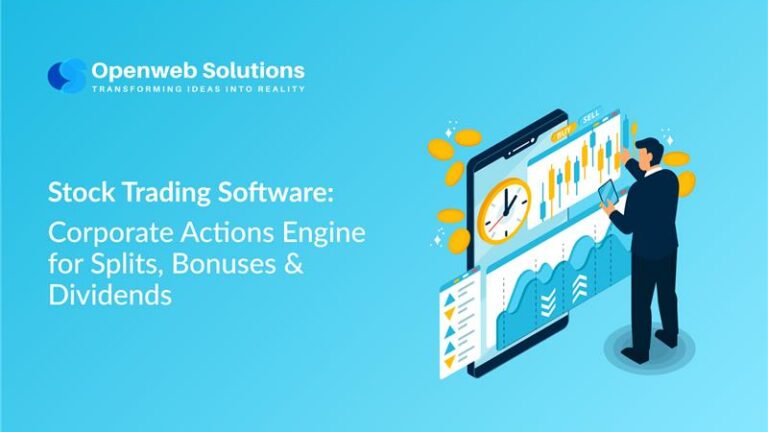
If you run a trading platform or a portfolio system, you already know corporate actions can make or break user trust. A split that does not reflect in time, a bonus share that fails to credit, or a dividend that posts with the wrong tax treatment can turn a great product into a support nightmare. This is exactly where a purpose built corporate actions engine inside your stock trading software pays off. In this guide, we unpack how a well designed engine handles splits, bonus issues, and dividends with accuracy, automation, and compliance at scale. We will also show how Openweb Solutions builds custom stock market programs and integrations that reduce exceptions, speed up posting, and keep regulators happy.
Why a corporate actions engine belongs in your stock trading software
Corporate actions look simple on the surface. A company announces a split or a dividend. Your system should reflect it. In practice, you must ingest announcements from multiple sources, normalize formats, validate against exchange data, calculate holdings across unsettled positions, update average cost, adjust derivatives where needed, and post cash or shares. All of this has to be right on ex date and record date.
A dedicated engine inside your stock trading software centralizes this job. It watches feeds, enriches them with reference and pricing data, applies event specific rules, simulates the effect across your books, and publishes updates to trading interfaces, statements, and downstream accounting. The result is fewer manual touch points, faster updates, and clean audits.
The market context your stock trading software must keep up with
Settlement cycles are getting faster. The United States completed its move to T plus one on May twenty eight, two thousand twenty four, with industry groups reporting a successful transition that relied on automation and strong testing.
Post transition surveys suggested the change hit cross border workflows harder than expected and increased the value of automation around corporate actions and exception handling.
India is pushing speed further. The regulator broadened the optional same day settlement path to the top five hundred stocks through a phased rollout that started in two thousand twenty five, with timelines adjusted to help brokers and market infrastructure update systems. These steps underline how time windows around ex date and record date keep shrinking for local and foreign participants.
Exchanges and clearing corporations publish rules for how derivatives and positions adjust when splits, bonuses, and dividends happen. Your engine should reconcile with these official references to keep its calculators correct.
Standards are evolving too. Many corporate action notifications still arrive on Swift MT messages such as MT five six four, while more counterparties add ISO twenty zero two two coverage. Planning for coexistence lets your platform automate cleanly while the industry completes migration.
What a corporate actions engine does inside stock trading software
1) Event ingestion and normalization in stock trading software
Your engine accepts feed inputs from exchanges, depositories, data vendors, issuer registrars, and news wires. It normalizes different payloads into a single event model. A stock split becomes a ratio with a clear before and after face value. A bonus issue becomes a ratio that leaves face value untouched. Validations ensure share capital logic and timelines match exchange and clearing guidance.
2) Eligibility, ex date, and record date logic
Eligibility is driven by holdings at record date, but positions often move around ex date with unsettled trades. The engine should include positions expected to settle, exclude selldowns that remove entitlement, and handle transfers so that breaks do not appear on pay date. This is vital as T plus one and optional T plus zero narrow the window to fix issues.
3) Eligibility, ex date, and record date logic in stock trading software
For splits, the engine multiplies quantities by the split factor and recomputes average cost per share so that total cost stays the same. For bonus shares, it credits new shares based on the ratio and recalculates per share cost across a higher quantity. Reports and tax lots must reflect these changes.
4) Dividend entitlements and tax handling
Cash dividend logic should cover interim, final, and special dividends, different rates for resident and nonresident clients, gross or net posting, and any reinvestment plans. The engine maps client tax status to the right rate, generates vouchers, and posts cash on pay date with full audit.
5) Workflow and exception management
Real systems see late announcements, revised terms, and symbol changes. The engine should surface exceptions, propose repairs, and support maker checker approval. It needs immutable logs of who changed what and when to back audits and reduce operational risk.
6) Position and P and L adjustments
A high quality engine recalculates average cost and realized and unrealized P and L after each event. It produces reconciliation files for back office and brokers and publishes change events to risk, margin, and reporting systems so downstream views stay in sync.
Stock trading software architecture that makes corporate actions run on time
Event model and rules engine
Use a unified event schema for splits, bonuses, and dividends. A rules layer maps event types to calculators, cutoffs, and posting flows. Store effective dates, ex dates, record dates, and pay dates as first class fields. This structure keeps code clean as you add rights issues, buybacks, or mergers later.
Data quality layer
Cross check issuer announcements against exchange pages and vendor feeds. Diff terms and alert on mismatches in split ratio or record date. Keep a change log. This aligns with the way timelines compress after T plus one and optional T plus zero, where getting it right the first time matters more.
ISO twenty zero two two and Swift messaging
Support both legacy MT and ISO twenty zero two two MX messages. Create adapters that translate incoming MT five six four into your internal model and publish outgoing confirmations in ISO twenty zero two two where counterparties accept it. This bridges the migration path that continues through two thousand twenty five.
Scheduling for T plus one and optional T plus zero
Build a scheduler that pulls feeds, runs calculators, and posts entitlements relative to ex date, not just record date. Include fast paths for same day settlement windows where your clients opt into T plus zero. Parameterize cutoffs so you can align with local exchange timings and the optional same day block deal window.
Testing and replay
Record input events and outputs for replay. Run simulation jobs for future dated actions to forecast balances and surface breaks before pay date. Provide a staging environment that mirrors production data shapes, which helps when regulations or standards change.
How the engine reduces risk across stock market software
Fewer fails and breaks. When markets went to T plus one in the United States, firms compressed timelines for postings and elections. Centralizing corporate actions and improving schedules helped keep exception volumes controlled. Where manual handling remained, sell side desks reported more strain, which highlights the payoff from automation.
Cleaner compliance. Your audit trail should show the source of every term, the calculator version used, approvals, and user activity. That lines up with exchange guidance on how adjustments flow into derivatives and equity books and helps pass audits with less back and forth.
Better client experience. Accurate balances by market open on ex date reduce support tickets and help traders trust the platform. Public dashboards of corporate filings and actions are widely used. Your stock market software can mirror this inside the app with alerts and previews sourced from official filings.
Blueprint: building a corporate actions engine with Openweb Solutions
Openweb Solutions designs and implements custom engines that fit your stack, whether you operate a retail broker, an advisory platform, or an institutional desk. We focus on data quality, standards, and performance so operations and compliance teams can work faster with fewer exceptions.
Discovery and data strategy
Start with the instrument universe and data vendors. Map every input you receive and every output you need, from portfolio screens to tax statements. Add validation sources such as exchange corporate filings and derivatives adjustment rules to reduce drift and improve match rates.
Event model and calculators
We deliver a unified event schema and calculators for splits, bonuses, and dividends. Calculators handle edge cases like odd lot rounding, fractional entitlements, special dividends that alter derivative strikes, and cash in lieu. All transformations are versioned and auditable.
Schedules tuned for faster settlement
We configure ex date and record date workflows for T plus one by default and T plus zero where enabled, including parameterized cutoffs for local exchange windows and optional same day block deal windows in India.
Standards and connectivity
We wire up Swift connections and message adapters so your system can consume MT and ISO twenty zero two two payloads and emit confirmations to custodians and clearing members. This prepares your platform for the two thousand twenty five standards landscape without disruptive rewrites.
Controls, dashboards, and exports
Operations teams get dashboards for upcoming events, eligibility counts, expected cash, and exceptions. Compliance teams get immutable logs and export packs. Finance teams get reconciliations and variance reports. Engineering teams get clear APIs and events to plug the engine into stock trade platforms and reporting services.
Performance and scalability
We instrument the engine to process millions of positions before market open. The architecture scales horizontally and uses idempotent jobs so reruns never double credit. We also provide replay to reproduce any posting and to test new calculators before promotion.
Practical tips to tune corporate actions in your stock trading software
- Pre calculate. For known upcoming ex dates, run entitlement previews so users can see projected quantities and cash. This reduces surprises and tickets.
- Handle unsettled trades with care. Include or exclude them based on exchange rules and your risk appetite and explain the policy to clients inside the app.
- Adjust average cost correctly. After a split or bonus, the total cost stays the same but the per share cost changes, so tax lots and P and L must refresh.
- Send proactive alerts. Push notifications for ex dates, record dates, and pay dates increase engagement and reduce confusion.
- Keep standards current. Track Swift and ISO releases and test message changes well ahead of deadlines.
- Plan for exceptions. Build repair screens for late changes and revised terms with maker checker control.
What to include in an RFP for a corporate actions engine
- Supported event types, starting with splits, bonuses, and dividends.
- Data sources and validation strategy against exchange pages.
- Eligibility and unsettled trade logic, including rules for T plus zero options.
- ISO twenty zero two two and MT message support with a migration plan.
- Scheduler design and cutoff configuration by market.
- Audit, reporting, and reconciliation deliverables.
- Throughput targets and recovery point objectives.
- Customization model and roadmap support grounded in your stock market software architecture.
Why Openweb Solutions is the right build partner
We specialize in custom stock market software for brokers, wealth platforms, and exchanges. Our teams understand how faster settlement and new standards change entitlement timing and reconciliation. We build engines that fit your technology choices and regulator expectations. The result is fewer exceptions, faster closes, and happier users.
We also bring a documentation mindset to every delivery. Your operations staff gets clear run books. Your compliance team gets exports that make audits simple and product team gets APIs and events to bring entitlement previews and alerts into user journeys.
Frequently Asked Questions
Q1. What is a corporate actions engine in stock trading software?
Ans: A corporate actions engine is a specialized service inside stock trading software that ingests issuer and exchange announcements, calculates entitlements for splits, bonus shares, and dividends, updates positions and cost basis, and posts cash or shares with full audit and reporting.
Q2. How do faster settlement cycles like T plus one and T plus zero affect corporate actions?
Ans: Faster cycles compress timelines for eligibility checks, postings, and reconciliations. After the United States moved to T plus one in May two thousand twenty four, schedules and exception handling needed tighter controls. India’s optional T plus zero path pushes even more automation and cutoff discipline for brokers and market infrastructure.
Q3. What standards should my engine support for corporate action messages?
Ans: Support legacy Swift MT messages such as MT five six four and plan for ISO twenty zero two two adoption. Build adapters so you can consume and produce both formats during the transition period through two thousand twenty five and beyond.
Q4. How are average cost and P and L affected by splits and bonuses?
Ans: Splits increase share count and reduce the per share cost proportionally, with total cost unchanged. Bonus shares credit new units while face value remains the same and the per share cost is recalculated across the larger quantity. Your engine should apply the correct math and update reports automatically.
Q5. What controls help with compliance and audits?
Ans: Keep a full audit trail of inputs, approvals, calculator versions, and postings. Reconcile against exchange guidance for adjustments, especially where derivatives are affected, and produce export packs for regulators and auditors.
Q6. Can Openweb Solutions integrate a corporate actions engine with existing stock trade platforms?
Ans: Yes. We design the engine as an independent service with clear APIs and message adapters so it plugs into your order management, portfolio, risk, and reporting systems without forcing a rewrite.
Conclusion: make corporate actions a strength in your stock trading software
Splits, bonus issues, and dividends are core to investor experience. The shift to faster settlement and richer messaging makes manual handling risky and expensive. A dedicated corporate actions engine gives your platform speed, accuracy, and compliance. Openweb Solutions can design and implement this engine to fit your business, your tech stack, and your market timelines so users see the right balances at the right time.
For adjacent capabilities, explore our brokerage back office solutions.
Sources
- U.S. SEC – Chair Gensler Statement on T+1 Implementation (May 21, 2024)
- DTCC – Comments on SEC Announcement: T+1 Implementation Date of May 2024
- DTCC – U.S. T+1 Settlement Is Here: What’s Next?
- SIFMA/ICI/DTCC – T+1 After Action Report (September 2024)
- Reuters – What to Expect as U.S. Moves Toward Faster Stock Settlement (May 28, 2024)
- Financial Times – Industry Hit by Significant Funding Gaps After Switch to T+1
- SEBI – Enhancement in the Scope of Optional T+0 Rolling Settlement (Dec 10, 2024)
- SEBI – Further Extension of Timeline for T+0 Systems by QSBs (Oct 30, 2025)
- Reuters – India Extends Deadline for Same-Day (T+0) Settlement Plan (Apr 29, 2025)
- NSE – T+0 Settlement Cycle (Overview and Circular Links)
- Swift – ISO 20022 Implementation FAQs (End of CBPR+ Coexistence: Nov 22, 2025)
- Swift – ISO 20022 for Financial Institutions: Payments Instructions
- ISO 15022 – MT564 Corporate Action Notification (UHB)
- Swift – Corporate Actions (MT564 Overview, PDF)
- NSE – Equity Derivatives: Corporate Actions Adjustments
- NSE Clearing – Corporate Actions Adjustment
- NSE – Corporate Filings: Corporate Actions Dashboard
- NSE – Corporate Filings: Event Calendar
- NSE Circular – Corporate Action Adjustment Example (FAOP68938, Jul 4, 2025)
- NSE Circular – Corporate Action Adjustment Example (FAOP69137, Jul 16, 2025)

Partha Ghosh is the Digital Marketing Strategist and Team Lead at PiTangent Analytics and Technology Solutions. He partners with product and sales to grow organic demand and brand trust. A 3X Salesforce certified Marketing Cloud Administrator and Pardot Specialist, Partha is an automation expert who turns strategy into simple repeatable programs. His focus areas include thought leadership, team management, branding, project management, and data-driven marketing. For strategic discussions on go-to-market, automation at scale, and organic growth, connect with Partha on LinkedIn.