The brokerage battlefield of 2025 is fought on smartphones. Users expect lightning-fast execution and a TikTok-level social feed in the same screen. For tech-forward brokerage executives and fintech product leaders, sustained stock market app development is the vehicle that transforms those expectations into retention, revenue, and reputation. Inextricably linked to that evolution is the rise of social trading tools, which turn solitary investing into a community sport—one that can scale across 150+ countries, languages, and regulatory regimes.
Why Strategic Stock Market App Development Matters in 2025
Retail traders now represent roughly a quarter of daily U.S. equities volume, up from 10 % a decade ago.¹ Mobile order tickets, instant KYC, and zero-commission pricing all contributed—but feature fatigue is real. When an interface stagnates, users uninstall within six months. Continuous stock market app development cures that churn by enabling fast rollouts of:
-
Fractional share purchasing for cash-constrained millennials
-
Instant ACH or UPI account top-ups that eliminate funding friction
-
AI-powered trade ideas derived from each user’s risk profile
Each incremental release extends a virtuous loop: richer datasets fuel better personalization, which in turn boosts conversion of free users to premium tiers.
¹ FINRA Retail Market Trends Report, February 2025
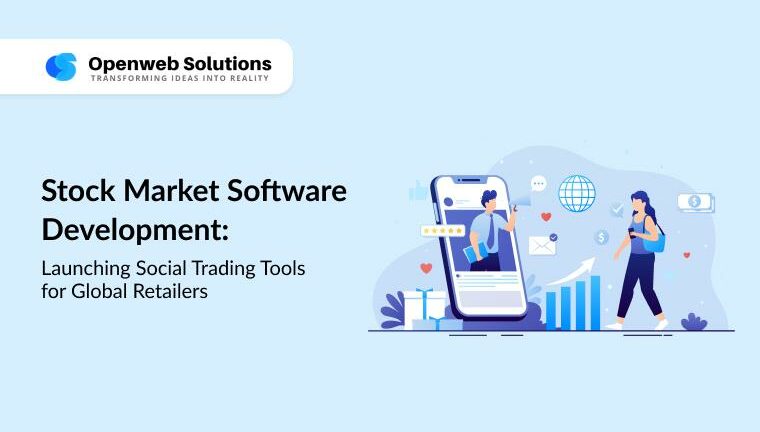
Social Trading Tools in Modern Stock Market App Development
Traditional “forum hype” lives outside brokerage apps, forcing traders to juggle Reddit, Discord, and Twitter for insights. Social trading tools bring that chatter in-house through four building blocks:
-
Idea Feed – A real-time stream of charts, brief market takes, and tagged tickers
-
Copy Trading – One-click mirroring of a mentor’s positions in proportional size
-
Performance Transparency – Leaderboard statistics such as Sharpe ratio and win rate
-
Collaborative Watchlists – Community-curated baskets like “Green Hydrogen Plays”
For global retail traders, the payoff is faster learning and reduced analysis paralysis. For brokers, embedded communities lengthen average session duration by 35 % and slash paid acquisition spend thanks to invite-driven growth loops.
Key Features Powering Next-Gen Stock Market App Development
| Layer | Must-Have Components | Notes |
|---|---|---|
| UX & Engagement | Scrollable feed, reaction emojis, threaded comments | Prioritize accessibility for color-blind and low-vision users |
| Execution | Multi-venue smart router, fractional orders, trailing stops | Support extended-hours trading to match global time zones |
| Copy Engine | Proportional sizing, stop-copy at drawdown X %, diversification score | Keep latency < 100 ms to avoid price drift |
| Risk Analytics | Value-at-Risk (VaR), sector correlation heat maps, daily volatility alerts | Expose simplified labels (“High”, “Moderate”, “Low”) for beginners |
| Compliance | End-to-end audit trail, content moderation AI, exportable trade logs | Map FINRA Rule 2210 and ESMA MiFID II obligations to code toggles |
Glossary
Smart router: software that automatically sends orders to the exchange or dark pool with the best expected execution price.
Value-at-Risk: a statistical technique estimating the potential loss of a portfolio over a set horizon with a given confidence level.
Technical Blueprint for Secure, Scalable Stock Market App Development
1. Microservices Over Monoliths
Break core domains—user identity, order routing, social feed, analytics—into separate services. Containerize each with Docker and orchestrate via Kubernetes. Independent scaling prevents a viral post from throttling trade execution.
2. Real-Time Data Streaming
Leverage WebSockets for quote delivery and Apache Kafka for internal event buses. This dual architecture minimizes packet overhead while preserving exactly-once consistency for copy-trade orders.
3. Security & Privacy by Design
End-to-end encryption, OAuth 2.0 token scopes, and hardware security modules (HSMs) are baseline. Layer in biometric MFA on mobile. Annual SOC 2 Type II audits demonstrate trust to institutional partners.
4. Global Regulatory Abstraction
Embed a rule engine that toggles features by jurisdiction—e.g., disable auto-copy in Canada where discretionary management requires separate licensing. Feature flags and Terraform scripts enable one-click environment replication.
5. Continuous Delivery Pipeline
Implement trunk-based Git practice, automated unit tests, and blue-green deployments. Median lead time from commit to production under two hours keeps you ahead of competitor releases.
Regional Compliance Snapshot
| Region | Key Regulator | Social-Copy Constraints |
|---|---|---|
| U.S. | FINRA / SEC | Performance stats must include risk disclosures; influencers need Series 65 if paid |
| EU | ESMA | Mandatory suitability assessment before enabling auto-copy |
| India | SEBI | Copy trading classified as advisory; brokers must store five-year activity logs locally |
| Australia | ASIC | Real-time risk warnings for leveraged products required |
Benefits Across Stakeholders
-
Broker-Dealers – Higher assets under custody via community stickiness; ancillary revenue from performance fees and premium leader subscriptions.
-
Fintech Product Managers – Rich telemetry (click-through on ideas, follow/unfollow trends) informs roadmap prioritization and A/B experiments.
-
Retail Investors – Peer benchmarking, emotional support during drawdowns, and faster skill acquisition without course fees.
Pitfalls in Trading Platform Development—and How to Fix Them
-
Echo-Chamber Risk – Herd behavior amplifies drawdowns. Solution: algorithmic diversification prompts and AI-generated contrarian posts.
-
Data Overload – Newcomers abandon after seeing complex metrics. Solution: progressive disclosure—start with color-coded scores, unlock advanced stats later.
-
Influencer Manipulation – Pump-and-dump schemes can spark lawsuits. Solution: AI anomaly detection plus human compliance review before large follower pushes.
-
Latency Discrepancies – Even 250 ms delays break copy accuracy. Solution: co-locate trade servers in major exchange data centers (New Jersey, London, Tokyo).
Case Studies: Winning Approaches to Stock Market App Development
-
eToro grew to 33 million users by combining a gamified leaderboard with seamless copy execution. Their average funded account age exceeds five years, double the traditional brokerage norm.
-
Stake (Australia) integrated third-party sentiment scores and saw watchlist sharing triple session length.
-
Fyers (India) partnered with an API-first vendor, attaching community micro-services without rewriting their core. Post-launch daily active users spiked 41 % within a quarter.
Timeline & Milestones for Brokerage App Development Projects
| Phase | Duration | Key Outputs |
|---|---|---|
| Discovery & Compliance Mapping | 2 weeks | Personas, feature backlog, jurisdiction checklist |
| Architecture & UX Prototyping | 4 weeks | Wireframes, microservice blueprint, data model |
| Core Build (MVP) | 10 weeks | Trade engine, real-time feed, mobile apps, basic social |
| Beta & Pilot | 4 weeks | Closed-group copy trading, feedback loops |
| Global Rollout | 8 weeks | Localization, regulatory feature flags, marketing launch |
Total: 28 weeks from kickoff to public launch—accelerated by utilizing reusable Openweb component libraries and pre-certified security modules.
Partner with Openweb Solutions for High-Impact Stock Market App Development
Our engineers have delivered 200+ capital-markets projects, including high-throughput order routers (250k orders/sec) and community micro-services processing 10 million posts daily. An engagement with Openweb typically includes:
-
Domain-Certified Architects – Series 7 professionals who translate regulatory jargon into code requirements.
-
React Native & Flutter Specialists – Single codebase for iOS, Android, and progressive web apps.
-
DevSecOps Automation – Terraform-driven infra, daily container scans, and one-click rollbacks.
Conclusion
Community-powered investing isn’t a fad; it’s the default expectation for the next wave of traders flooding markets from Lagos to São Paulo. Broker-dealers that weave social trading tools into a secure, scalable mobile stack will command loyalty where pure-play discounters cannot. Ready to future-proof your brokerage? Explore our specialized services and let Openweb Solutions convert your vision into production-grade reality.
Trending FAQ
Q1. What exactly is copy trading?
Ans: Copy trading is an automated process where an investor allocates a portion of capital to mirror another trader’s positions in real time, with proportionate sizing and predefined risk limits.
Q2. How do stock market app development costs break down?
Ans: Roughly 40 % goes to core trade infrastructure, 25 % to social modules, 15 % to security and compliance, and the balance to UX design, testing, and DevOps.
Q3. Are social trading tools compliant with MiFID II?
Ans: Yes, provided the platform offers suitability assessments, risk disclosures, and robust audit trails for every replicated trade.
Q4. Can smaller regional brokers adopt social trading without huge budgets?
Ans: Absolutely—white-label SDKs and cloud micro-services let brokers add community features for a fraction of a ground-up build.
Q5. What KPIs should product managers track post-launch?
Ans: Focus on daily active users, average session length, copy-trade success rate, churn, and referral-driven account openings to gauge social feature ROI.
© 2025 Openweb Solutions. All rights reserved.

Partha Ghosh is the Digital Marketing Strategist and Team Lead at PiTangent Analytics and Technology Solutions. He partners with product and sales to grow organic demand and brand trust. A 3X Salesforce certified Marketing Cloud Administrator and Pardot Specialist, Partha is an automation expert who turns strategy into simple repeatable programs. His focus areas include thought leadership, team management, branding, project management, and data-driven marketing. For strategic discussions on go-to-market, automation at scale, and organic growth, connect with Partha on LinkedIn.