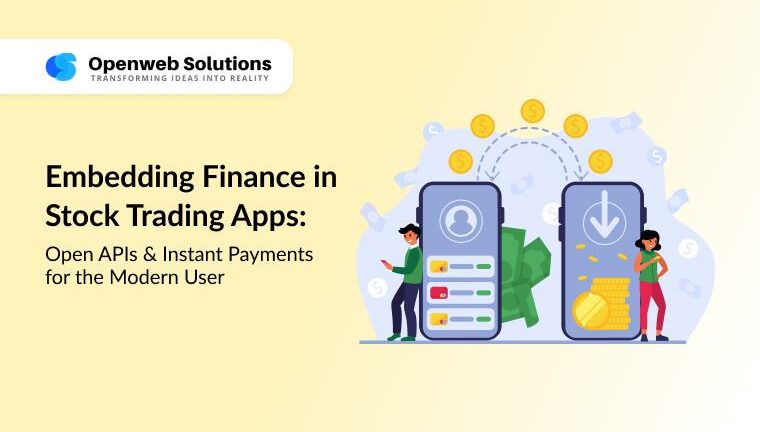
Modern investors expect the same immediacy from their portfolios that they get from ride-sharing or food delivery. For decision-makers evaluating stock market website development, the strategic question is no longer should we embed finance but how fast can we deploy it. Add to that the rise of real-time rails like India’s UPI (18 billion transactions monthly) and the accelerating FedNow® rollout in the United States, and it’s clear that money moves at the speed of code. Whether you’re planning green-field stock market app development or upgrading an existing brokerage portal, embedding finance through open APIs unlocks game-changing user experiences and revenue models.
1. Why Embedded Finance is Critical in Stock Market Website Development
Users no longer tolerate multi-day funding lags or manual KYC loops. By integrating banking-as-a-service (BaaS) providers, trading apps can offer:
- Instant account funding and withdrawals. Real-time payment rails credit portfolios in seconds, letting traders seize fleeting price action instead of waiting for ACH settlement.
- On-platform wallets. White-label e-money accounts keep capital inside your ecosystem, boosting engagement and order frequency.
- Contextual upsells. From margin lending to thematic baskets, embedded finance lets you surface monetizable micro-services at the moment of intent.
Critically, embedding these flows during stock market website development decouples financial features from your core order-routing logic. You build once; APIs handle the heavy lifting of compliance, reconciliation, and reporting.
2. How Open APIs Future-Proof Stock Market App Development
A decade ago, brokerages stitched together monolithic systems. Today, RESTful JSON endpoints and OAuth 2.0 tokens let you swap components like LEGO® bricks:
| Capability | Typical API Partner | Key Tech Notes |
| KYC & AML | RegTech vendors | Biometric liveness, sanctions screening |
| Payments-in | RTP, UPI, PIX, FedNow® | ISO 20022 messages, webhook confirmations |
| Brokerage execution | Clearing brokers | FIX/FAST order feeds, fractional routing |
| Analytics | Data as a Service | Streaming tick data, AI-driven insights |
During the second phase of stock market website development, engineers can wire these APIs into a service mesh, enabling blue-green deployments and zero-downtime upgrades. Regulation-forward jurisdictions such as the EU’s forthcoming PSD3 explicitly champion this open-finance model, giving early adopters compliance headroom for years to come.
3. Instant Payments: From Funds-In to Fractional Shares in Seconds
Nothing kills conversion like asking a user to wait. With instant payment rails:
- Funds settle faster than price quotes expire. A user can top up ₹10,000 via UPI and buy ITC shares before the next candlestick forms.
- Risk exposure shrinks. Real-time irrevocable transfers mean you’re not extending credit while ACH or NEFT clears.
- Treasury gets leaner. Lower float requirements free capital for product innovation instead of prefunding corridors.
To capture these wins, architects embed idempotent payment endpoints, webhook listeners, and ledger micro-services that post transactions atomically. Building this natively into stock market website development outperforms retrofitted payment gateways that still settle D+2.
Conclusion: Build the Platform Your Traders—and Regulators—Trust
Open-finance rails are evolving weekly, yet your roadmap can keep pace when modular APIs insulate your stack from change. By weaving embedded finance, real-time payments, and battle-tested security controls into your stock market software development cycle, you deliver a trading experience that feels effortless to users and reassuring to compliance teams.
If you’re ready to transform ambition into execution, our engineers specialize in stock market website development that ships fast, scales globally, and stays audit-ready. Contact us today to discuss a bespoke blueprint that turns every millisecond—and every customer interaction—into measurable market advantage.
❓ Frequently Asked Questions (FAQs)
Q1. What features should a modern stock market website include to support embedded finance?
Ans: A modern stock market website should integrate real-time payment gateways (like UPI, FedNow®), instant KYC/AML verification via RegTech APIs, on-platform digital wallets, contextual upselling tools, and secure brokerage execution systems. These embedded finance features not only improve user experience but also increase revenue opportunities.
Q2. How do open APIs improve the scalability of stock market software development?
Ans: Open APIs enable modular architecture, allowing developers to plug in or replace services like payments, data analytics, and trade execution without overhauling the entire system. This modularity ensures faster updates, zero-downtime deployments, and future-proof scalability for your trading platform.
Q3. What role do instant payments play in user retention for stock trading apps?
Ans: Instant payments drastically reduce the time between fund transfer and trade execution. Users can fund their accounts and buy stocks in seconds—boosting engagement, reducing churn, and increasing trust. This real-time experience is now expected in modern stock market app development.
Q4. Is it safe to embed financial services in a stock trading platform using third-party APIs?
Ans: Yes—when done properly. Partnering with regulated BaaS providers and using secure protocols like OAuth 2.0 and TLS encryption ensures compliance and data protection. Plus, most APIs come with built-in auditing, reconciliation, and transaction security features to safeguard financial flows.
Q5. How does real-time integration with systems like UPI or FedNow® benefit stock market website development?
Ans: Real-time rails like UPI (India) or FedNow® (US) allow instant account funding and withdrawal, reducing operational float, eliminating T+2 delays, and enhancing user satisfaction. Embedding these systems natively during development streamlines fund movement and builds trust with time-sensitive traders.

Partha Ghosh is the Digital Marketing Strategist and Team Lead at PiTangent Analytics and Technology Solutions. He partners with product and sales to grow organic demand and brand trust. A 3X Salesforce certified Marketing Cloud Administrator and Pardot Specialist, Partha is an automation expert who turns strategy into simple repeatable programs. His focus areas include thought leadership, team management, branding, project management, and data-driven marketing. For strategic discussions on go-to-market, automation at scale, and organic growth, connect with Partha on LinkedIn.