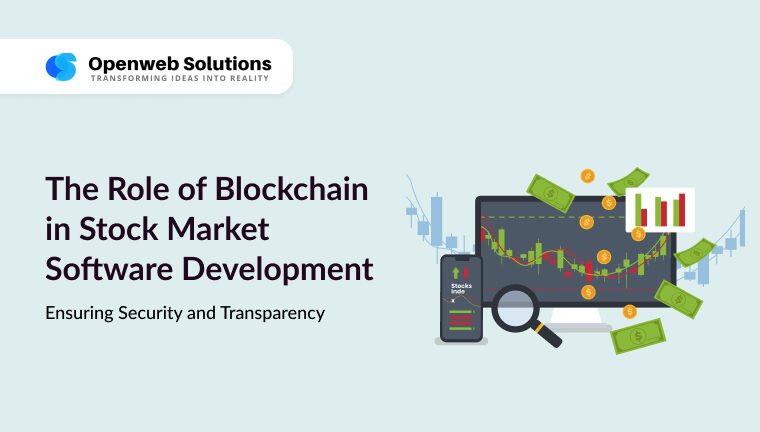
In recent years, the financial industry has undergone a significant transformation with the rise of blockchain technology, especially in the realm of stock market software development. With increasing threats of data manipulation and security breaches, integrating blockchain has become a necessity—not a choice—for developers creating secure and transparent trading platforms. From stock market app development to trading automation and decentralized finance, blockchain is redefining how the financial world functions.
Strengthening Security in Stock Market Software Development
Security is a cornerstone of any robust stock market software development process. Traditional platforms, built on centralized databases, are highly susceptible to cyberattacks, data tampering, and insider trading. Blockchain counters these threats by leveraging a decentralized ledger where transactions are:
-
Encrypted
-
Immutable
-
Distributed across multiple nodes
This makes unauthorized data access nearly impossible.
Additionally, smart contracts automate trade execution based on predetermined conditions. These self-executing contracts eliminate the need for human intervention, thereby reducing errors, fraud, and potential manipulation. Integrating blockchain into stock market applications ensures a level of security that traditional platforms struggle to offer.
Boosting Transparency in Stock Market App Development
Transparency is another significant advantage of using blockchain in stock market app development. Traditional trading systems often operate in silos, where users have limited insight into trade execution or order flows. Blockchain technology transforms this by maintaining a public ledger accessible to all stakeholders in real time.
Key benefits include:
-
Real-time transaction visibility
-
Time-stamped, permanent records
-
Reduced dependency on intermediaries
-
Lower operational costs and faster settlements
This level of openness fosters trust among investors, regulators, and brokers, laying the foundation for a healthier and more efficient trading ecosystem.
Driving Innovation in Stock Market App Development
Stock market app development is evolving rapidly with blockchain enabling more agile, user-friendly, and efficient platforms. The integration of decentralized finance (DeFi) allows:
-
Peer-to-peer trading, bypassing traditional exchanges
-
24/7 trading access, improving flexibility
-
Tokenization of stocks, enabling fractional ownership
This opens doors for retail investors who were previously priced out of expensive shares. It also enhances liquidity in the market and improves accessibility, allowing a broader audience to participate in stock investments securely and conveniently.
Blockchain’s Influence on Stock Market Website Development
For firms focused on stock market website development, incorporating blockchain offers a competitive edge. Blockchain integration enhances:
-
User data protection
-
Cyber threat mitigation
-
Transaction integrity and traceability
Advanced features such as real-time settlement, automated compliance, and decentralized identity verification can be added to improve the user experience and regulatory adherence. These advantages position blockchain-powered websites as more trustworthy and innovative in the digital finance space.
Conclusion: Blockchain as a Pillar for the Future
To sum up, blockchain is not just a technological upgrade—it is a transformational force in stock market software development. By enhancing security, transparency, and operational efficiency, it sets the standard for next-generation trading platforms. Companies investing in blockchain-driven stock market app development will lead the way in creating trusted, scalable, and future-proof solutions.
Furthermore, businesses engaged in stock market website development should strongly consider blockchain integration to future-proof their platforms and stay ahead in the competitive financial technology landscape.
FAQs on Blockchain in Stock Market Software Development
Q1. How does blockchain improve security in stock market software development?
Ans: Blockchain decentralizes data storage, encrypts transactions, and maintains immutable records across multiple nodes, making data breaches nearly impossible. Smart contracts further strengthen security by automating trade execution.
Q2. Why is transparency important in stock market app development, and how does blockchain help?
Ans: Blockchain provides a real-time, publicly accessible ledger that ensures full transaction visibility, reduces fraud, and eliminates the need for intermediaries.
Q3. What role does blockchain play in stock market website development?
Ans: It enhances security protocols, prevents cyber threats, and allows features like real-time settlement and decentralized identity checks to improve transparency and reliability.
Q4. How does blockchain impact stock market liquidity and accessibility?
Ans: By enabling fractional ownership through tokenization and offering peer-to-peer trading, blockchain increases liquidity and opens investment to a wider audience.
Q5. What is the future of blockchain in stock market software development?
Ans: As adoption grows, blockchain will become essential for real-time trading, compliance automation, and secure transaction processing, making it a pillar of future stock market solutions.

Partha Ghosh is the Digital Marketing Strategist and Team Lead at PiTangent Analytics and Technology Solutions. He partners with product and sales to grow organic demand and brand trust. A 3X Salesforce certified Marketing Cloud Administrator and Pardot Specialist, Partha is an automation expert who turns strategy into simple repeatable programs. His focus areas include thought leadership, team management, branding, project management, and data-driven marketing. For strategic discussions on go-to-market, automation at scale, and organic growth, connect with Partha on LinkedIn.